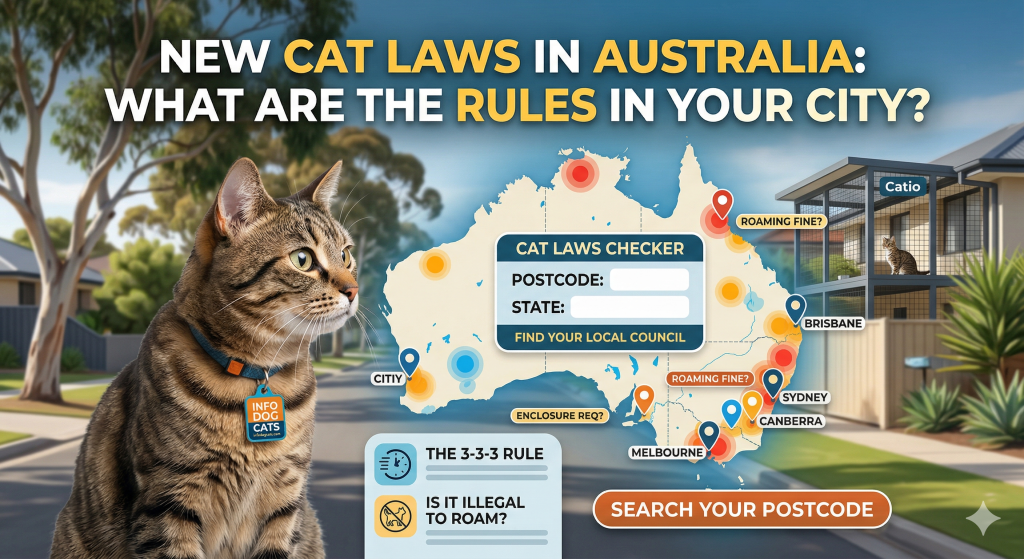
Cat laws in Australia depend on your state and your council. Here's what each state and territory requires for microchipping, registration and desexing, where cats must be contained, what's changing, and how to keep an indoor cat happy.
Cat laws in Australia are made at two levels. State and territory governments set the main rules on microchipping, registration and desexing. Local councils add their own rules, especially on cat numbers, curfews and containment. That means the rules for your cat can change when you move a few suburbs away.
Advertisement
This guide summarises the main cat laws in each state and territory, explains how curfews and containment work, covers what's changing, and has tips for keeping a contained cat happy. Laws change, so always check your state government and council websites for the current rules.
The basics that apply almost everywhere
Most Australian cat owners need to:
- Microchip their cat, usually by 12 weeks of age and always before it's sold or given away.
- Keep microchip details up to date, so a lost cat can be returned.
- Register their cat with their council, in most states and territories.
- Desex their cat by a set age in several states and territories, unless they hold a breeder permit or an exemption.
- Follow council rules on cat numbers and containment.
Anyone selling or giving away kittens usually has extra obligations, such as microchipping before sale and including identification numbers in advertisements.
State and territory rules
Australian Capital Territory
The ACT has some of the strictest cat laws in Australia.
- Registration: Cats over 8 weeks old that have been in the ACT for 28 days or more must be registered. There's a one-off registration fee, and registration must be renewed every year at no charge.
- Microchipping and desexing: Cats must be microchipped and desexed. Keeping an undesexed cat requires a permit, which can be granted for breeding or showing, or if desexing would harm the cat's health.
- Containment: Cats born on or after 1 July 2022 must be contained to their owner's premises 24 hours a day, anywhere in the ACT. Older cats must also be contained if they live in one of the suburbs previously declared cat containment areas. A cat counts as contained if it's inside, in a secure enclosure, or under control on a harness and lead.
New South Wales
NSW cat laws are set by the Companion Animals Act 1998.
- Microchipping: Cats must be microchipped by 12 weeks of age, or before sale or transfer if that happens first.
- Registration: Since July 2024, cats must also be registered on the NSW Pet Registry by 12 weeks of age, or immediately when ownership changes.
- Desexing: Cats not desexed by four months of age need an annual permit, in addition to registration, unless an exemption applies.
- Containment: Under the current Act, NSW councils can't impose cat curfews or containment orders across their area, which makes NSW different from most states. The NSW Government reviewed its companion animal laws in 2025, and councils and conservation groups asked for powers to introduce containment. Check the Office of Local Government website for any changes.
Victoria
Victorian cat laws are set by the Domestic Animals Act 1994 and council orders.
- Registration: Cats must be registered with their council from three months of age, and registration is renewed every year by 10 April.
- Microchipping: Cats must be microchipped before they can be registered.
- Desexing: Many councils require cats to be desexed before they're registered for the first time, with exemptions for some breeders and for health reasons. Fees are much lower for desexed cats.
- Containment: Victorian councils can make orders requiring cats to be confined at night or at all times, and more than half have introduced containment rules. Surf Coast Shire, for example, requires all cats to be confined to their owner's premises 24 hours a day.
- Selling kittens: Anyone advertising a kitten for sale or to give away must include a Pet Exchange Register source number and the kitten's microchip number. See our guide to Burmese kittens for sale in Melbourne for how this works.
Queensland
Queensland's main cat law is the Animal Management (Cats and Dogs) Act 2008, and councils set most of the detail through local laws.
- Microchipping: Cats must be microchipped before 12 weeks of age, and before they're sold or given away. The seller is responsible.
- Registration: Requirements vary by council. Some councils require registration, usually within a set time of the cat turning 12 weeks old. Others, such as Brisbane, don't require cats to be registered, but limit how many cats you can keep without a permit.
- Containment: Some councils require cats to be kept on their owner's property. Check your council's local laws.
- Feral cats: Feral cats are a restricted invasive animal in Queensland, and it's an offence to feed, move, give away, sell or release one.
South Australia
South Australia's rules are set by the Dog and Cat Management Act 1995.
- Microchipping: Since 1 July 2018, all cats must be microchipped by 12 weeks of age or before sale.
- Desexing: Cats born after 1 July 2018 must be desexed by six months of age, or within 28 days of purchase if that's later. Cats owned by registered breeders are exempt from desexing.
- Breeders: Anyone who breeds cats for sale must register with the Dog and Cat Management Board and include their registration number in advertisements.
- Councils: Councils can make by-laws on cat registration, numbers and confinement. Check yours.
Western Australia
Western Australia's rules are set by the Cat Act 2011.
- Registration: Cats aged six months or older must be registered with their local government. A registered cat must wear its registration tag in public.
- Microchipping and sterilisation: Cats over six months must be microchipped and sterilised, unless they're owned by an approved breeder or a vet certifies an exemption.
- Containment: Local governments can make local laws about where cats are allowed. Check your council.
Tasmania
Tasmania updated its Cat Management Act 2009, with the main changes taking effect in 2021 and 2022.
- Microchipping and desexing: Since 1 March 2022, all cats over four months old must be microchipped and desexed, unless a vet exempts them or they're kept by a breeder with a permit.
- Cat numbers: You can't keep more than four cats over four months old on one property without a multiple cat permit. Breeders and approved foster carers are exempt.
- Breeding: You need a cat breeding permit to breed cats.
Northern Territory
There's no territory-wide cat registration law in the Northern Territory. Councils set the rules through by-laws. In Darwin, for example, cats over three months old, or that have lived in Darwin for a month, must be registered and microchipped. Desexing is strongly recommended and registration fees are lower for desexed cats, and there are limits on the number of cats per property. Check your council's by-laws.
Advertisement
Curfews and 24-hour containment
What containment means
A cat curfew or containment rule means your cat must stay on your property, either at night or at all times. "Contained" usually means indoors, in a secure outdoor enclosure (catio), or in a fully cat-proofed yard. Some rules also allow a cat to be out on a harness and lead under your control.
Why councils are introducing containment
- Wildlife. Each roaming pet cat kills an estimated 110 native animals a year, and about 71% of pet cats are allowed to roam. See our guide to feral cats in Australia.
- Cat safety. Roaming cats are hit by cars, injured in fights, attacked by dogs, and exposed to diseases such as FIV.
- Nuisance and strays. Containment reduces complaints about cats in neighbours' yards, and reduces unplanned litters.
What happens if your cat roams
Where containment applies, a roaming cat can be seized by council officers or trapped by residents and taken to the pound, and owners can be fined. Fines and procedures vary by council. Our guide to trapping feral cats explains how council trapping works.
The national picture
There's no single national cat law. In December 2024, the federal government and the states and territories agreed a new Threat Abatement Plan for Predation by Feral Cats. Alongside measures for feral cats, it encourages responsible pet ownership, including desexing and containment, and aims to make pet cat laws more consistent across states and territories. It doesn't force any state to change its laws.
Ideas such as limiting the number of cats per household have been discussed publicly, but any such rule would be up to states and councils.
Breed rules
There are no national bans on domestic cat breeds. Hybrids with wild cats, such as the Savannah, can't be imported, and since 1 March 2026 Bengal cats can no longer be imported into Australia. See our guide to which cat breeds are allowed in Australia.
How to keep a contained cat happy
If your cat has always roamed, the switch to an indoor life takes some planning. Most cats adjust well with the right setup.
- Make the change gradually. Start by keeping your cat in from dusk to dawn, then extend the time inside.
- Build or buy a catio. A secure enclosure gives fresh air, sun and things to watch. Window boxes and balcony enclosures work in small spaces. See our guide to cat enclosures and catios.
- Add height. Cat trees, shelves and window perches let cats climb and survey their territory. See our guide to cat scratching posts and cat trees.
- Play every day. Two or more short play sessions with a wand toy, plus puzzle feeders, satisfy the urge to hunt. See our guide to interactive cat toys.
- Provide scratching posts, hiding places and comfortable beds in several rooms. See our guide to cat beds.
- Keep litter trays clean, with at least one tray per cat plus one extra in multi-cat homes. See our guide to cats peeing outside the litter tray.
- Try harness training. Many cats learn to enjoy supervised outings on a harness. See our guide to cat harnesses.
If your cat seems stressed by the change, for example by spraying, overgrooming or yowling at doors, talk to your vet.
Settling a new cat
If you've just adopted a cat, expect it to take time to settle into an indoor home. The "3-3-3 rule" is a rough guide: about three days to decompress, three weeks to learn the routine, and three months to feel at home. Our guide to cat body language and sounds explains the rule and how to read your cat's signals.
Checklist for cat owners
- Is your cat microchipped, and are the details in your name and up to date?
- Is your cat registered with your council, if required?
- Is your cat desexed, or do you have the permit or exemption your state requires?
- Do you know your council's rules on cat numbers and containment?
- If you sell or give away kittens, do you know the advertising rules in your state?
Frequently asked questions
Is it illegal for cats to roam in Australia?
It depends on where you live. In the ACT, cats born on or after 1 July 2022 must be contained at all times. Many Victorian councils, and councils in other states, have curfews or 24-hour containment. Under current NSW law, councils can't impose containment, though that may change.
Do I have to register my cat?
In most states and territories, yes. In NSW, cats must be on the NSW Pet Registry by 12 weeks of age. In Victoria, registration is required from three months, and in Western Australia from six months. In Queensland and the Northern Territory, it depends on your council.
Is microchipping compulsory?
Yes, in every state and territory except the Northern Territory, where it depends on council by-laws. In most places it must be done by 12 weeks of age and before a cat is sold or given away.
Do I have to desex my cat?
In the ACT, South Australia (for cats born after 1 July 2018), Western Australia and Tasmania, desexing is required unless an exemption or breeder permit applies. In NSW, you need an annual permit for a cat not desexed by four months. Many Victorian councils require desexing for registration.
How many cats can I own?
It depends on your state and council. In Tasmania, the limit is four cats over four months old without a permit. Many councils elsewhere set limits, with permits available for more cats.
Can my cat go outside on a lead in a containment area?
In the ACT, a cat on a harness and lead under your control counts as contained. Check your council's rules elsewhere.
What should I do if my neighbour's cat keeps coming into my yard?
Talk to your neighbour first. If your council has containment rules, contact its animal management team. See our guide to trapping feral cats for how council trapping works.
Advertisement