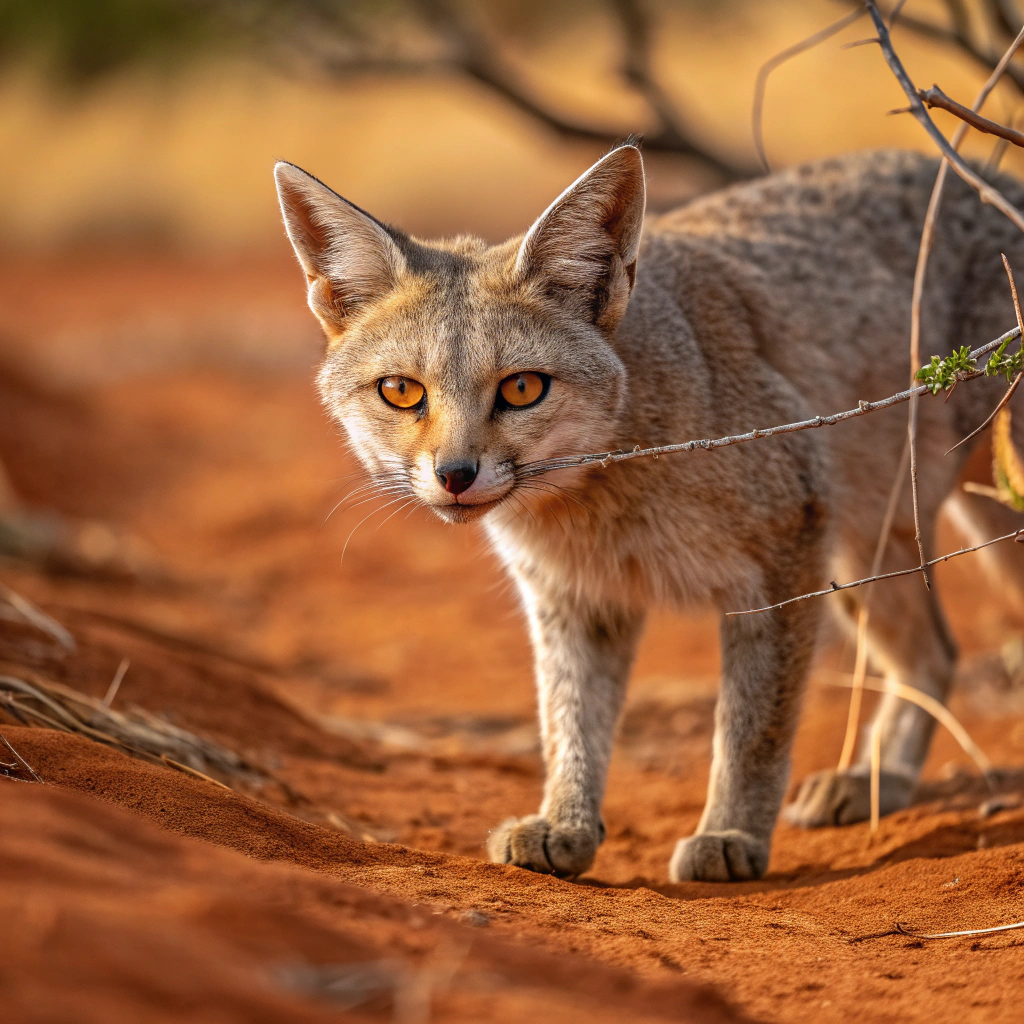
Australia has between about 2 and 6 million feral cats, and they kill well over a billion native animals a year. Here's how the numbers are worked out, how cats spread across the continent, what governments are doing about them, and how pet owners can help.
Feral cats live almost everywhere in Australia, from the deserts of the centre to alpine forests and offshore islands. They're one of the biggest threats to Australia's native wildlife, and they've played a part in many of the country's mammal extinctions.
Advertisement
This guide covers what a feral cat is, how cats got to Australia, how many there are, how many native animals they kill, what the national plan to manage them involves, how they're controlled, and what cat owners can do to help.
What is a feral cat?
A feral cat is a domestic cat (Felis catus) living in the wild, with no owner. Feral cats find all their own food, shelter and mates. They're the same species as pet cats, but they've usually had little or no contact with people and live and behave as wild animals.
It helps to separate three groups:
- Pet cats have an owner who feeds and cares for them. Some are kept indoors and some are allowed to roam.
- Stray or semi-owned cats live around towns, farms, rubbish tips and industrial areas. They rely on people for food, either directly from someone who feeds them or indirectly from rubbish and other scraps.
- Feral cats live independently of people in the bush, on farms and on islands.
Cats move between these groups. A dumped or lost pet can become a stray, and the kittens of strays can grow up feral.
Are there any native wild cats in Australia?
No. Australia has no native species of the cat family. Animals sometimes called "native cats", such as quolls, are carnivorous marsupials, not cats. Every wild cat in Australia descends from domestic cats brought here by people.
Feral cats look like ordinary tabby, ginger, black or tortoiseshell cats. In Queensland, the state government describes adult feral males as typically weighing 3 to 6 kg and females 2 to 4 kg. They're often leaner and more muscular than pets.
How cats got to Australia
Cats arrived with European settlers. Domestic cats came on the First Fleet in 1788 and continued to arrive on ships through the 1800s.
A 2015 genetic study of 266 feral cats from the mainland and islands, led by researcher Katrin Koch, found that Australia's feral cats descend mainly from cats brought by European settlers in the 19th century. It found no population that could be traced only to Asia, and judged it unlikely that cats arrived earlier with Asian seafarers.
Cats spread with settlement and pastoralism. Some escaped and others were released deliberately, in the hope they would control rabbits and rodents. By 1890, historical records show cats were established across the mainland and Tasmania, apart from a small area in the north Kimberley and some offshore islands.
How many feral cats are there in Australia?
The most widely used estimate comes from a 2017 study led by ecologist Sarah Legge, which brought together nearly 100 separate studies of cat density across the country.
- Natural environments. The study estimated between 1.4 million feral cats after continent-wide droughts and 5.6 million after extensive wet periods, when prey is plentiful.
- Highly modified environments. A further 0.7 million feral and stray cats live in towns, around rubbish tips and on intensive farms.
- Total. That puts the national feral population at roughly 2.1 to 6.3 million, depending on conditions.
- Range. Cats were found across more than 99.8% of Australia's land area, including many islands.
In largely natural landscapes, the average density is about 0.3 cats per square kilometre. Density is much higher on many islands and in towns, and it rises and falls with rainfall in arid areas.
Pet cats
Australia also has about 3.8 million pet cats, according to the same research program. A later study found that about 71% of pet cats were allowed to roam at least some of the time. Together with feral cats, that gives a total of around 6.6 million cats in most years.
How many native animals do cats kill?
A series of studies by Australia's Threatened Species Recovery Hub estimated how many animals cats kill each year. The figures are estimates with wide margins, but they show the scale of the problem.
Feral cats
In largely natural landscapes, feral cats kill an estimated:
- 272 million birds a year, 99% of them native species. An average feral cat kills about 129 birds a year.
- 815 million mammals a year, mostly native species.
- 470 million reptiles a year, almost all native.
The federal environment department estimates that feral cats kill more than 1.5 billion native mammals, birds, reptiles and frogs a year, plus about 1.1 billion invertebrates.
All cats
Adding feral cats in modified environments and pet cats, all cats in Australia together kill more than a million birds every day, about 1.14 billion mammals a year, and about 650 million reptiles a year.
Which species?
Cats are known to prey on 357 Australian bird species, about half of all native bird species, including most threatened birds. They also prey on 258 reptile species and 151 mammal species, more than half of Australia's native mammals. For more detail on what feral cats eat and how their diet changes with the seasons, see our guide to what feral cats eat in Australia.
Pet cats count too
Pet cats kill far fewer animals each than feral cats, but there are many more of them in towns and suburbs, where they hunt in much higher densities. The researchers estimated that each roaming pet cat kills about 110 native animals a year, made up of roughly 40 reptiles, 38 birds and 32 mammals. Only about 15% of the prey that pet cats catch is brought home, so most owners have no idea how much their cat hunts.
Cats and extinctions
Australia has lost an unusually large share of its mammals since European settlement. A 2015 review found that about 11% of Australia's 273 endemic land mammal species have become extinct, and another 21% are threatened. By comparison, only one native land mammal has become extinct in North America over the same period. The federal environment department says cats have been implicated in 28 mammal extinctions. They're now a threat to more than 200 nationally listed threatened species, and a major cause of decline for animals such as bilbies, bandicoots, bettongs and numbats.
Most of the species lost were small and medium-sized mammals in the "critical weight range", between about 35 grams and 5.5 kg, a convenient meal size for cats and foxes. The review identified predation by these two introduced predators as the main cause, with changed fire patterns also playing a part.
Case study: numbats at Dryandra Woodland
Dryandra Woodland, in Western Australia's wheatbelt, is one of the last natural strongholds of the numbat, Western Australia's animal emblem. Numbats are endangered, and at times there have been fewer than 1,000 left in the wild.
Fox baiting at Dryandra had helped numbats recover for years. But as fox numbers fell, feral cats became the main predator. By 2014 there were estimated to be only about 50 numbats left at Dryandra.
During a trial of the Eradicat cat bait in the main block of Dryandra between 2012 and 2015, the proportion of numbat deaths caused by feral cats fell from 50% to zero. With more intensive cat control, ongoing fox baiting and good seasons, numbers have since recovered. A survey in 2025 estimated about 536 numbats in the main block. Surveyors also noted small increases in cat detections, a reminder that cat control has to continue for the gains to last.
What governments are doing
A key threatening process
Advertisement
Predation by feral cats is listed as a "key threatening process" under the federal Environment Protection and Biodiversity Conservation Act 1999. That listing requires a national threat abatement plan setting out how the threat will be managed.
The 2024 threat abatement plan
The first plan was published in 2008 and replaced in 2015. In September 2023, federal Environment Minister Tanya Plibersek released a draft of a new plan for public consultation. The draft had a ten-year horizon, with an estimated cost of about A$60 million in the first five years. More than 1,600 responses were received. The final Threat Abatement Plan for Predation by Feral Cats was registered in December 2024, made jointly with the states and territories.
The plan focuses on:
- Eradicating cats from islands and creating more cat-free fenced areas, known as havens, for the most vulnerable species.
- Ongoing control where threatened species can survive if cat numbers are kept low.
- Better habitat management, such as fire and grazing management in northern Australia's savannas.
- Reducing rabbits in southern Australia, which cats rely on as food.
- Research into new and more effective control tools.
- Pet cats, by encouraging desexing and containment and working towards more consistent cat laws across states and territories.
The plan doesn't force states and territories to change their laws. Domestic cat rules, such as registration, desexing and curfews, are mostly set by state governments and local councils. Ideas such as limiting the number of cats per household have been discussed publicly, but they're up to states and councils. See our guide to cat laws in Australia.
State declarations
States also manage feral cats under their own laws. For example:
- Victoria declared feral cats an established pest animal on specified Crown land in July 2018. The declaration covers public land managed by the state, not private land.
- Western Australia declared feral cats a pest in 2019, which allows natural resource management and biosecurity groups to control them alongside the state's conservation programs.
- Queensland lists the feral cat as a restricted invasive animal. It's an offence to feed, move, give away, sell or release one.
How feral cats are controlled
There's no single solution. Most programs combine several methods, chosen to suit the landscape and the species being protected.
- Baiting. Eradicat is a 1080 bait developed in Western Australia for feral cats. Curiosity uses the toxin PAPP inside a small hard-shell pellet. Cats tend to swallow large chunks of meat whole, while many native animals chew their food and reject the pellet, which reduces the risk to non-target species. Both are restricted products that only authorised people can use.
- Felixer grooming traps. These solar-powered units use sensors to recognise cats and foxes and spray a dose of toxic gel onto their fur, which the cat swallows as it grooms. In a South Australian trial, none of the 1,024 non-target animals and objects that passed the units were sprayed, and Western Australian trials reduced cat activity by up to 49%.
- Trapping and shooting. Cage traps work best in towns and small areas, and padded-jaw traps and shooting by licensed operators are used in the bush. Trapping is slow and labour intensive over large areas. Our guide to trapping feral cats covers how it's done and where trapped cats can go.
- Fencing and islands. Predator-proof fences and cat-free islands protect populations of the most vulnerable species. Several mammals that have disappeared from the mainland now survive mainly in these havens.
- Landscape management. Reducing rabbits, managing fire and grazing to keep ground cover, and protecting dense vegetation all make it harder for cats to hunt.
Research is ongoing into new tools, including better baits and long-term options such as genetic approaches. All control has to be humane and comply with state animal welfare laws.
What cat owners can do
Pet cats can't fix the feral cat problem on their own, but responsible ownership stops new cats joining the feral population and protects wildlife in towns and suburbs.
- Keep your cat contained. Keep it indoors, with access to a secure enclosure or catio if possible. This protects wildlife and keeps your cat safe from cars, fights and disease. See our guide to cat enclosures and catios.
- Desex your cat. Unplanned litters are a major source of strays and ferals.
- Microchip and register. A microchipped, registered cat that gets lost can be returned home instead of ending up as a stray.
- Never dump a cat. Abandoning an animal is cruel and illegal. If you can't keep your cat, contact a shelter or rescue group.
- Don't feed strays. Feeding stray cats helps them breed. Contact your council or a local rescue group about desexing and rehoming instead.
- Keep an indoor cat busy. Play, climbing spaces and puzzle feeders make indoor life easier. See our guides to interactive cat toys and cat scratching posts and cat trees.
You can also report feral cat sightings to your council or a citizen science program, and support local groups that protect wildlife habitat.
Frequently asked questions
How many feral cats are there in Australia?
Between about 2.1 and 6.3 million, depending on conditions. Numbers rise after wet years, when prey is abundant, and fall during droughts.
How many birds do cats kill in Australia?
Feral cats in natural landscapes kill an estimated 272 million birds a year, and all cats together kill more than a million birds a day. Almost all of them are native species.
Are feral cats bigger than pet cats?
Most are a similar size. In Queensland, adult males typically weigh 3 to 6 kg and females 2 to 4 kg, though they tend to be leaner and more muscular than pets.
Can feral cats be tamed?
Adult feral cats rarely become comfortable living with people, because they missed the early socialisation that pet cats get. Young kittens can often be tamed if they're handled from an early age. See our guide to trapping feral cats.
Why not just desex feral cats and release them?
Trap-neuter-return programs aren't considered effective for feral cats in the Australian bush. Desexed cats still hunt, and it isn't practical to catch enough cats across such huge areas. In many states, releasing a cat can also be treated as abandonment, or breach pest laws. Free and low-cost desexing for owned and semi-owned cats in towns is a different approach, and some councils use it to reduce stray numbers.
Are cat curfews worth it?
Containing pet cats protects wildlife in towns and suburbs and reduces the number of cats that become strays. Many councils now require cats to be contained at night or at all times.
Advertisement