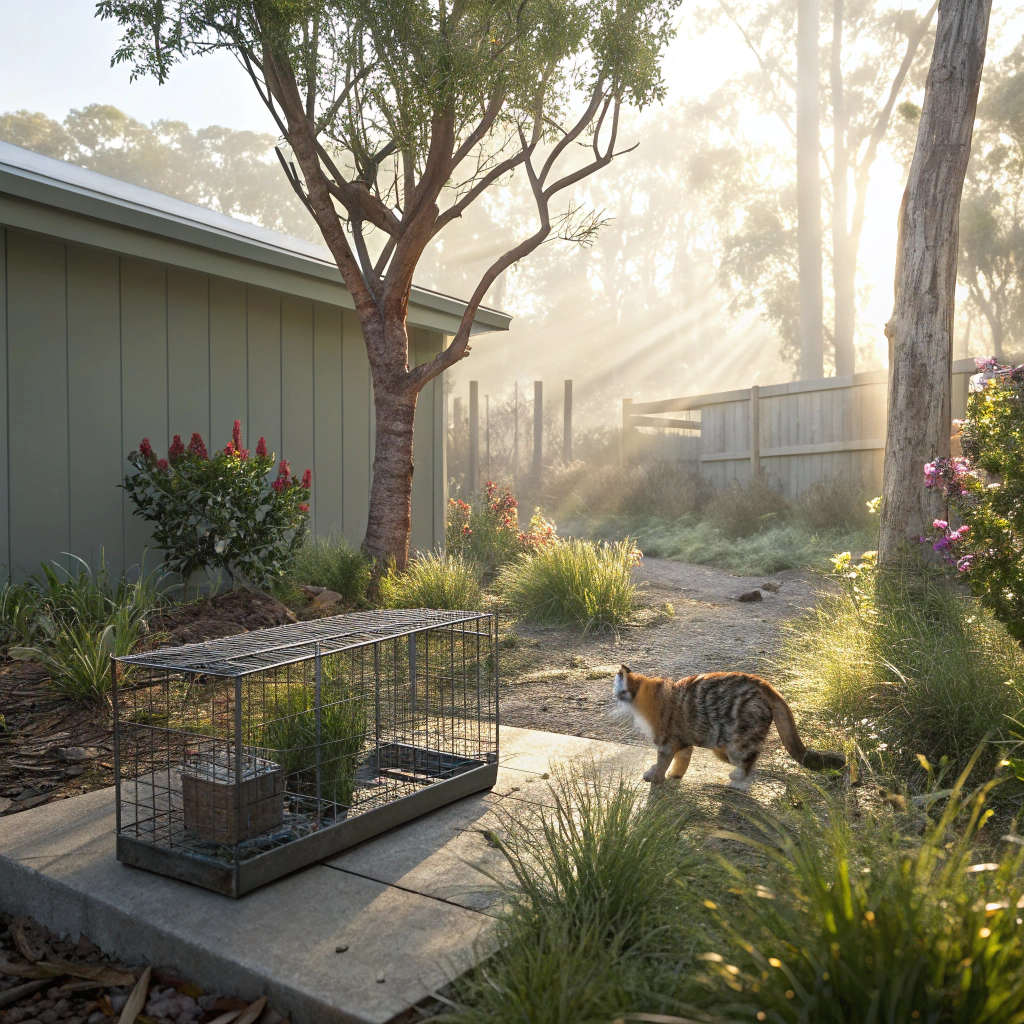
Trapping a feral or stray cat is legal in many situations in Australia, but the rules depend on your state and council. Here's what to check first, how to choose and set a cage trap humanely, what to do once a cat is caught, and where you can take it.
A cat that keeps visiting your yard can be a nuisance and a threat to local wildlife. It might be a feral cat, a stray that someone feeds, or a neighbour's pet that's allowed to roam. Before you do anything, it's worth knowing which it is, what your state and council allow, and where a trapped cat can go.
Advertisement
This guide covers how to tell feral, stray and pet cats apart, the laws to check before you trap, how to borrow and use a cage trap humanely, what to do once a cat is caught, and where you can take it.
Feral, stray or someone's pet?
- Feral cats live without any owner, find all their own food and shelter, and avoid people. They're usually impossible to handle.
- Stray or semi-owned cats live around houses, businesses, farms and tips, and are fed by people, deliberately or with scraps. Some are lost or dumped pets. Some are friendly and some are not.
- Pet cats have an owner. Many roam, especially in areas with no curfew, and some will wander into neighbouring yards.
You often can't tell from a distance. A cat that looks wild may be a timid pet, and a friendly cat may be a stray. That's why any trapped cat has to be checked for a microchip before anything else happens.
For background on feral cat numbers and their impact on wildlife, see our guide to feral cats in Australia.
Check the rules before you trap
Cat laws are made by states and territories, and councils add their own local laws. Before you set a trap, contact your council's animal management team. Many councils will explain their rules, lend or hire you a trap, and tell you where to take a trapped cat.
Here are some examples of how the rules differ.
New South Wales
In NSW, councils generally manage cat trapping through their own trap hire programs. Conditions vary, but they can include:
- signing a statutory declaration explaining why you need the trap
- paying a refundable deposit
- a short hire period, often one to two weeks
- using the trap only on your own property, not on public land
- checking the trap at least daily
- taking any trapped cat to the council's pound or animal management facility so it can be scanned.
Councils point out that cats aren't prohibited from roaming in most of NSW, and that it can be an offence to seize a cat that isn't injured, abandoned or lost. Follow your council's process rather than acting on your own.
Victoria
Victoria declared feral cats an established pest animal in 2018, but only on specified Crown land managed by state agencies. The declaration doesn't cover private land.
On private land, landholders can cage-trap cats that repeatedly trespass on their property, and any cat trapped on private land must be handed to the local council. The council scans it and returns it to its owner if it has one. Many Victorian councils also have cat curfews or 24-hour containment rules, which affect what happens when a roaming pet is caught.
Queensland
Queensland lists the feral cat as a restricted invasive animal under the Biosecurity Act 2014. It's an offence to feed, move, give away, sell or release a feral cat. Everyone also has a general obligation to take reasonable steps to manage the risks from invasive animals on their land.
Some Queensland councils lend cat traps for use in urban areas. Contact your council about trap loans and where trapped cats should go.
Western Australia
Western Australia declared feral cats a pest in 2019, allowing natural resource management and biosecurity groups to run control programs. Pet cats are covered separately by the Cat Act 2011, which requires them to be registered, desexed and microchipped. Trapped cats are checked for collars, tags and microchips to identify pets.
Animal welfare law applies everywhere
Feral or not, every cat is protected by state animal welfare laws. It's an offence to be cruel to an animal or cause it unnecessary harm, including a declared pest. In Western Australia, for example, penalties for cruelty under the Animal Welfare Act 2002 go up to $50,000 and five years' imprisonment. Trapping has to be done humanely, and only vets or other authorised people may euthanise a cat.
Choosing a cage trap
In towns and suburbs, a wire cage trap is the right tool. A cat walks in for the bait, steps on a plate, and the door closes behind it. The animal isn't hurt, so a pet or a non-target animal can simply be released.
Look for:
- A treadle-plate trigger. National standard operating procedures for feral cat trapping recommend treadle-plate traps. Traps where the bait hangs from a hook can injure cats, and cats often won't take bait from a hook.
- The right size. A trap of about 74 cm long by 31 cm wide and 31 cm high suits most adult cats.
- Strong, fine mesh. Welded wire mesh with small openings stops cats reaching the bait through the sides and reduces injuries.
Borrowing a trap from your council is often the cheapest option, and it means you're already following their process. Rural trapping with padded-jaw traps, shooting and baiting are done by trained, licensed operators in organised programs, not by householders.
How to set a trap humanely
Before you start
- Tell your neighbours. Let them know you're trapping, so they can keep their cats inside, especially between dusk and dawn.
- Plan for daily checks. Only set the trap if you can check it at least once a day, every day, until you take it down. Many people check much more often.
- Know where you'll take a cat. Confirm opening hours with your council pound or vet before you set the trap. Some council facilities don't accept cats after hours or on weekends.
- Watch the weather. Don't trap in extreme heat, cold or heavy rain, when a trapped cat could suffer from exposure.
Bait and placement
- Bait. Put a handful of strong-smelling food at the very back of the trap, behind the trigger plate. Tinned cat food, sardines, tuna and raw chicken all work. Tuna oil drizzled near the entrance can help.
- Placement. Set the trap where you've seen the cat: along fence lines, near shelter such as bushes or under a deck, or where it comes to feed. Keep vegetation clear so the cat can walk around the trap before going in.
- Stability. Set the trap on level ground and peg it down or weigh it so it doesn't rock. A wobbly trap scares cats off.
- Cover. Covering the top and sides with a hessian bag or old towel makes the trap feel like a safe hiding place and stops the cat reaching the bait through the mesh. It also gives shade and shelter once a cat is caught.
Timing
Setting the trap in the late afternoon and checking it first thing in the morning catches most cats and reduces the chance of catching birds. If you leave the trap set during the day, check it again in the afternoon. Provide water in hot weather and bedding in cold weather.
Mothers and kittens
Avoid trapping in bushland and on rural properties from September to March, when many females are feeding kittens. If you catch a female that's obviously feeding kittens, search nearby for the kittens. Take them with her, or ask your council or a rescue group for help. Kittens left behind will starve.
Once a cat is caught
Advertisement
- Stay calm and quiet. Approach slowly and cover the trap with a towel or blanket if it isn't already covered. Most cats settle in the dark.
- Don't open the trap. Don't try to handle the cat. A frightened cat can cause deep bites and scratches. If you're bitten, clean the wound and see a doctor. Anyone who traps regularly should keep their tetanus vaccination up to date.
- Release non-target animals. If you've caught a possum, bandicoot, bird or other animal, open the door and step back. Take an injured animal to a vet or contact a wildlife rescue group.
- Transport the trap safely. Keep the trap covered, secure it so it can't slide around, and put plastic or newspaper underneath. Never put a trapped cat in a closed car boot.
- Go straight to the drop-off point. Don't leave a trapped cat in the sun or rain, or overnight without checking it.
Where to take a trapped cat
Your council pound or animal management facility
This is usually the first choice, and in many areas it's the only place you're allowed to take a trapped cat. The council will:
- scan the cat for a microchip and check the pet registry
- contact the owner if the cat is microchipped
- hold the cat for a set period so an owner can claim it, usually longer if it's microchipped
- assess unclaimed cats for rehoming, or arrange humane euthanasia by an authorised person if the cat is feral or unsuitable.
Some councils contract this work to a local shelter, such as an RSPCA shelter or animal welfare league. Your council will tell you which facility to use.
A vet
A vet can scan a cat for a microchip and contact the owner or the council. Vets aren't generally obliged to accept a cat unless it's injured, so call first. If a cat is clearly hurt or sick, take it to the nearest vet.
Animal shelters
Some shelters accept stray cats directly, often on behalf of the local council. Policies vary, so call ahead.
Rescue groups
Volunteer rescue groups usually take friendly stray cats and young kittens that can be rehomed. They rarely have room for truly feral adult cats. Our guide to kittens for adoption in Melbourne lists shelters and rescue groups that take in cats.
Places not to take a cat
Never release a trapped cat somewhere else, such as in bushland, a park or another suburb. Dumping a cat is cruel, it's an offence under animal welfare laws, and in Queensland releasing a feral cat breaches biosecurity law. The cat will also keep hunting wildlife wherever it ends up.
Can a feral cat be tamed?
It depends mostly on age. Kittens are most open to bonding with people between about two and seven weeks of age, the sensitive period for socialisation. Kittens caught at that age and handled gently every day by several different people can usually become good pets.
Older kittens take longer and may always be shy. Adult cats that grew up without human contact rarely become comfortable living with people. A friendly adult cat, on the other hand, is quite possibly someone's lost or dumped pet, and should be scanned and reported.
What about trap-neuter-return?
Trap-neuter-return (TNR) means trapping stray cats, desexing them and releasing them where they were found. It's common in some other countries, but in Australia it sits in a legal grey area. Releasing a cat can be treated as abandonment under animal welfare law, or breach pest laws. In Queensland, it's illegal to feed, remove or release non-domestic cats, including urban strays. A 2014 bill to legalise TNR in NSW lapsed. The Australian Veterinary Association has said TNR hasn't been shown to be effective under Australian conditions, because desexed cats still hunt wildlife.
Community cat desexing programs
A different approach has had good results in some Australian towns. Instead of releasing cats, councils offer free desexing, microchipping and registration for cats that people already feed, so those people can take ownership of them.
In Banyule, in Melbourne's north-east, a council-funded free desexing program that began in 2013 targeted suburbs with the most cat complaints. Over eight years, cat impoundments fell by 66%, euthanasia by 82% and cat-related calls to council by 36%. If you've been feeding a stray, ask your council or a local welfare group whether a free or low-cost desexing program is available. Then desex, microchip, register and contain the cat as your own.
Stopping cats from coming back
Trapping one cat won't help for long if your yard keeps attracting others.
- Remove food. Don't leave pet food outside, keep bins sealed, and clean up around barbecues and chicken coops.
- Block shelter. Seal gaps under houses, decks and sheds where cats can hide or have kittens.
- Protect wildlife. Plant dense, prickly shrubs where birds nest, and put bird baths and feeders where cats can't ambush them.
- Talk to neighbours. If the cat is a roaming pet, a friendly conversation is the first step. If it keeps happening, ask your council about local cat containment rules. See our guide to cat laws in Australia.
If you have a cat yourself, keep it contained with a secure enclosure or catio, so it isn't the cat causing problems next door. See our guide to cat enclosures and catios.
Frequently asked questions
Is it legal to trap a cat on my property?
In many places, yes, but it depends on your state and council. Some councils require you to use their trap and follow their conditions, and in most places a trapped cat must go to the council so it can be scanned. Contact your council before you start.
Can I take a feral cat to the RSPCA?
Sometimes. Some RSPCA shelters accept stray cats on behalf of local councils, but not all of them do. Call your nearest shelter or your council first.
What happens to feral cats at the pound?
They're scanned for a microchip and held for a set period in case an owner comes forward. Unclaimed cats are assessed: friendly cats may be rehomed, and cats that are truly feral are usually humanely euthanised by an authorised person.
How often should I check a cat trap?
At least once a day, and preferably first thing in the morning and again in the afternoon. Never leave a trap set when you can't check it, and check it more often in hot or cold weather.
What's the best bait for a cat trap?
Strong-smelling food works best: tinned cat food, sardines, tuna or raw chicken. Put it at the very back of the trap, behind the trigger plate.
What if I catch my neighbour's cat?
Release it, or take it to the council if your council's rules require that. Then talk to your neighbour about keeping their cat contained. Many councils have rules about cats roaming.
Should I feed a stray cat?
Feeding a stray without desexing it helps it breed, and in Queensland feeding a feral cat is an offence. If you want to help a friendly stray, ask your council or a rescue group about desexing, microchipping and rehoming, or take ownership of it yourself.
What do feral cats eat?
Mostly small native mammals, birds, reptiles and insects, plus rabbits and rodents where they're common. Our guide to what feral cats eat in Australia explains their diet in detail.
Advertisement