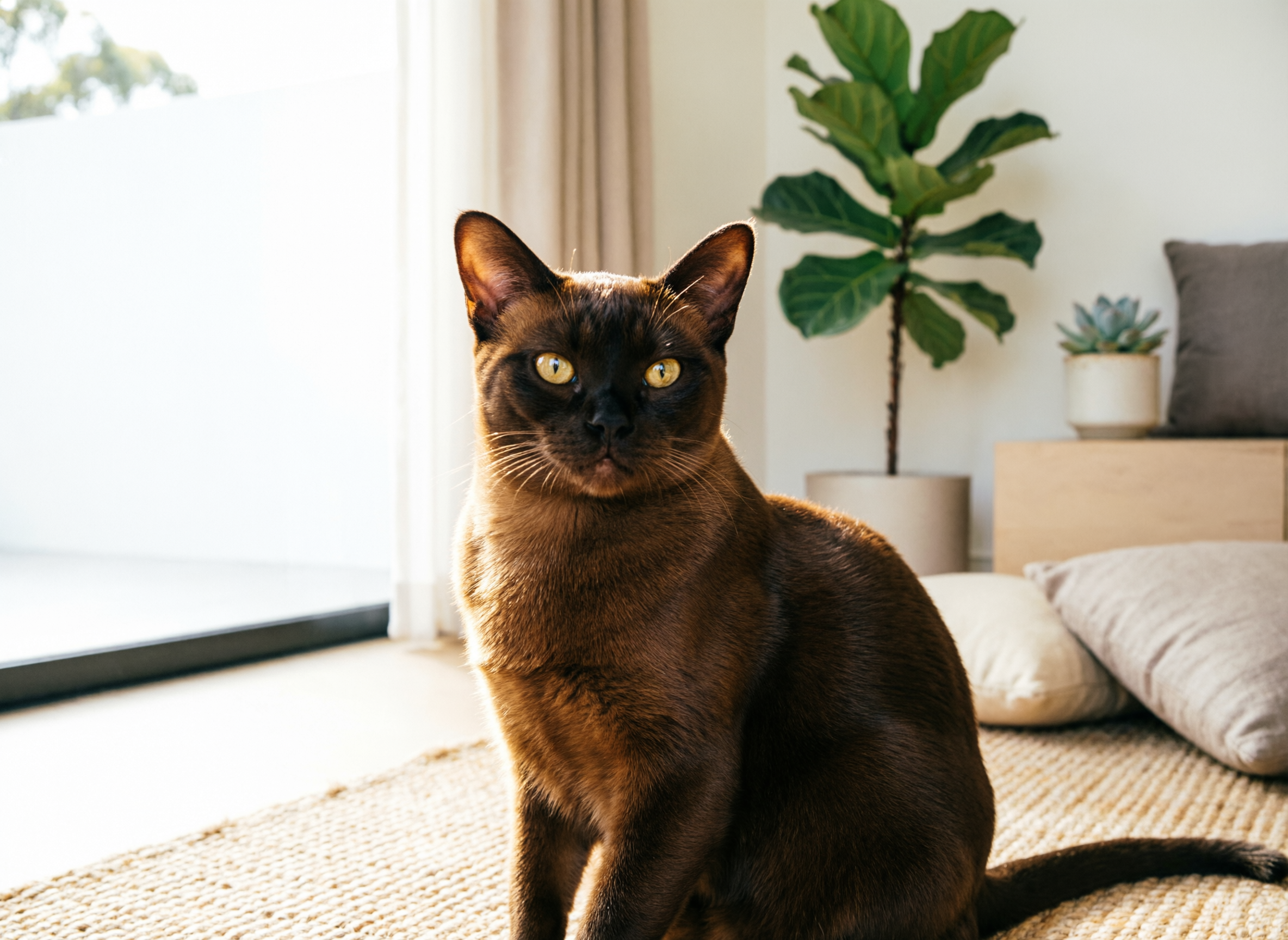
Burmese are one of Australia's best-loved pedigree cats: glossy, golden-eyed and devoted to their people. Here's where the breed came from, the colours you'll see in Australia, the health problems breeders test for, and what it's really like to live with one.
The Burmese is one of the most familiar pedigree cats in Australia. With its short, satin-like coat, golden eyes and muscular little body, it's often described as "a brick wrapped in silk". Owners tend to talk about personality first, though. Burmese are known for being affectionate, sociable and very involved in whatever their people are doing.
Advertisement
This guide covers where the breed came from, the colours you'll see in Australia and the genetics behind them, the Burmese personality, the health problems responsible breeders test for, and the care a Burmese needs.
Where the Burmese came from
The modern Burmese traces back to one cat. In 1930, Dr Joseph Thompson brought a small, dark brown female called Wong Mau from Burma (now Myanmar) to San Francisco. She was bred with a Siamese, and then with her own son, to produce the dark brown kittens that founded the breed.
Wong Mau herself later turned out to be a cross between the Burmese and Siamese types. Her mixed type was eventually developed as a separate breed, the Tonkinese.
The Cat Fanciers' Association in the United States first recognised the Burmese in 1936, but suspended recognition about a decade later because breeders kept crossing back to Siamese. Recognition was later restored.
Burmese also reached Britain, where breeders developed their own line. Most countries, Australia included, got their first Burmese from Britain rather than America, and Australian breed standards follow the British, or European, type. By around 1970, Burmese in the newer colours, including red, cream, chocolate and lilac, were being imported into Australia and New Zealand.
European and American Burmese
Because the breed developed separately on each side of the Atlantic, there are two broad types today.
- European (or traditional) Burmese are the type bred in Australia, the UK and much of Europe. They have a slightly more oval, moderate head and come in ten recognised colours.
- American Burmese have a rounder head and shorter muzzle. The main US registry, the Cat Fanciers' Association, recognises only four colours.
In the late 1970s, a US Burmese stud with a very short, rounded head became extremely popular, and his line became known as the "Contemporary" Burmese. That line carries the gene for a severe birth defect, covered in the health section below.
Colours
The ten Australian colours
Burmese in Australia, the UK and Europe come in six solid colours:
- Brown, the original Burmese colour: a rich, warm dark brown. In the US it's called sable.
- Blue, a soft grey with a warm, silvery sheen.
- Chocolate, a warm milk-chocolate shade. In the US it's called champagne.
- Lilac, a pale, pinkish dove grey. In the US it's called platinum.
- Red, a light tangerine.
- Cream, a pale cream.
There are also four tortoiseshell patterns, mixing red or cream with brown, blue, chocolate or lilac. Torties are almost always female, because the orange colour gene sits on the X chromosome.
The Cat Fanciers' Association recognises only sable, blue, champagne and platinum, so you may see those four names on American breeder sites.
The genetics of the Burmese colour
The Burmese look comes from a variant of the gene that controls colour (the tyrosinase gene). The Burmese variant, often written cb, partly restricts pigment, turning what would be a black cat into the warm brown of a brown Burmese, and the other colours into their softer Burmese shades. A Burmese has two copies of it.
The Siamese has its own variant of the same gene, cs, which restricts colour much more and produces a pale body with dark points. A cat with one Burmese copy and one Siamese copy has an in-between colouring called mink, which is the classic look of the Tonkinese.
Like the Siamese variant, the Burmese variant is temperature sensitive. That's why the cooler parts of a Burmese, the face, ears, legs and tail, can be a little darker than the body.
The Burmese look is completed by gold to yellow eyes, which stand out against every coat colour. When you meet a litter, ask the breeder to show you adult cats of the same colour, so you know how your kitten's coat and eyes are likely to look once it's grown.
Personality
Breeders and owners describe the Burmese in strikingly similar terms:
- People-oriented. Most Burmese want to be near their people, follow them from room to room, and greet them at the door.
- Affectionate. Many are enthusiastic lap cats and like to sleep close to their owners.
- Playful. Burmese often stay playful well into adulthood, and many learn to fetch.
- Talkative. They chat to their owners, though usually in a softer voice than a Siamese.
- Confident and curious. Visitors, new things and other pets are usually investigated rather than avoided.
That sociability comes with a catch. Burmese generally don't enjoy being left alone for long periods. If everyone in your home is out all day, breeders often suggest getting two cats so they can keep each other company.
Their confidence and trust also make Burmese vulnerable outdoors. They tend to approach strangers, cars and dogs rather than run away. Many breeders require buyers to keep Burmese indoors or with access to a secure cat enclosure, which also protects wildlife. A growing number of Australian councils require cats to be contained anyway. See our guide to cat laws in Australia.
Health
Burmese are generally robust cats, but the breed has several inherited conditions. Responsible breeders know about them, test for the ones that can be tested, and are open about the results.
Hypokalaemia
Burmese hypokalaemia is an inherited condition in which the cat's blood potassium levels drop, causing episodes of muscle weakness. Affected cats may walk stiffly, struggle to hold their head up, or seem reluctant to move. It usually responds well to potassium supplements.
In 2012, researchers identified the mutation responsible, in a gene called WNK4, and a DNA test followed. The condition is recessive: a cat needs two copies of the mutation to be affected. When two carriers are mated, each kitten has a 25% chance of being affected. Testing lets breeders avoid carrier-to-carrier matings.
Diabetes
Burmese in Australia have a well-documented higher risk of diabetes mellitus. A 1997 study of 4,402 cats published in the Australian Veterinary Journal found Burmese significantly over-represented among diabetic cats. A later study at Brisbane veterinary clinics found diabetes in 22.4 Burmese per 1,000, compared with 7.6 per 1,000 domestic short-haired and long-haired cats.
Advertisement
Research suggests Australian-bred Burmese have a higher risk than Burmese bred in the US, most likely because of the particular cats the Australian breed descended from.
Keeping a Burmese lean is the most useful thing you can do. Weigh food rather than guessing, limit treats, encourage play, and watch for the early signs of diabetes: drinking and urinating more, a bigger appetite and weight loss. See our guide to how often to feed your cat for portion control.
Feline orofacial pain syndrome
Feline orofacial pain syndrome (FOPS) is a painful condition of the mouth and face. Affected cats paw at their mouth, lick or chew exaggeratedly, and may stop eating. Episodes are often triggered by mouth movements or by teething in kittens. In a UK study of 113 affected cats, 100 were Burmese, suggesting an inherited cause. It's uncommon, but worth knowing about, because it's easily mistaken for dental pain or behaviour problems.
Burmese head defect
Kittens that inherit two copies of a variant of the ALX1 gene have a severe craniofacial defect that is not compatible with life. The variant comes from the American "Contemporary" Burmese line. Cats with one copy may have a shortened face. A DNA test is available, and breeders using cats with American ancestry should test for it.
GM2 gangliosidosis
GM2 gangliosidosis is a rare inherited disease of the nervous system. Affected kittens develop tremors and poor coordination from around 6 to 8 weeks of age, and it is fatal. It's recessive, and a DNA test lets breeders identify carriers.
Other things to watch
Like any cat, a Burmese needs regular dental care, vaccinations, and parasite prevention. Ask your vet to check your cat's teeth at every visit, and see them early if your cat starts eating differently or pawing at its mouth.
Lifespan
In a large UK study of cats seen at veterinary practices, published in 2015, Burmese had a median age at death of 14.3 years, a little longer than the 14.0-year median for all cats in the study. The number of Burmese was small, but it's consistent with the breed's reputation for living well into its teens.
Caring for a Burmese
Grooming
The Burmese coat is short and fine, with very little undercoat, so it's one of the easiest coats to care for. A weekly brush or a rub down with a rubber grooming mitt removes loose hair and keeps the coat glossy. Check the ears and trim claws as needed, and brush teeth if your cat will tolerate it.
Food and weight
Feed a complete and balanced diet in measured amounts. Burmese are often keen eaters, and an overweight Burmese has an even higher risk of diabetes. Use puzzle feeders and play to keep mealtimes active.
Play and company
Burmese need daily play and interaction. Wand toys, fetch games, puzzle feeders and climbing spaces all help. Our guides to interactive cat toys and cat scratching posts and cat trees have ideas. Many Burmese also take well to harness training. See our guide to cat harnesses.
Indoor life
A Burmese kept indoors needs things to do: windows to watch from, high places to climb, toys rotated regularly, and ideally a secure outdoor enclosure. See our guide to cat enclosures and catios.
Is a Burmese right for you?
A Burmese is likely to suit you if:
- someone is home for much of the day, or you're happy to have two cats
- you want a cat that's involved and affectionate rather than independent
- you can keep your cat indoors or in a secure enclosure
- you're prepared to manage its weight carefully
It may not be the best choice if you're out for long hours every day and only want one cat, or if you'd prefer a quieter, more independent animal.
Finding a Burmese
Buy from a breeder registered with a recognised cat council, who can show you DNA test results for the parents and will tell you which tests they do. Expect to be asked plenty of questions, and possibly to join a waiting list. Our guide to Burmese kittens for sale in Melbourne explains how to find and check a breeder, and the rules for buying a kitten in Victoria.
Adult Burmese occasionally need new homes through breed rescue networks, breeders rehoming retired cats, or general shelters. An adult cat's personality is already known, which can make for an easier match.
Frequently asked questions
Are Burmese cats good with children?
Many Burmese are confident, tolerant and playful, which makes them a popular family cat. As with any cat, teach children to handle the cat gently and supervise young children.
Do Burmese cats get along with other pets?
Most Burmese are sociable and adapt well to other cats and cat-friendly dogs, especially when introduced gradually. Many do best with another cat for company.
Are Burmese cats high maintenance?
Their coat needs very little care, but they need plenty of company and play. They're low maintenance to groom and high maintenance for attention.
Do Burmese cats shed?
All cats shed, but the Burmese coat is short with little undercoat, so shedding is light. No cat breed is truly hypoallergenic.
What health tests should a Burmese breeder do?
Ask about DNA tests for Burmese hypokalaemia and GM2 gangliosidosis, and for the Burmese head defect if the cats have American ancestry. Ask whether there is any diabetes or FOPS in the breeder's lines.
How long do Burmese cats live?
In a UK study of cats at veterinary practices, the median age at death for Burmese was 14.3 years. Many live longer with good care.
What's the difference between a Burmese and a Tonkinese?
The Tonkinese descends from crosses between Burmese and Siamese. Many Tonkinese have the in-between mink colouring, with a more visible contrast between body and points than a Burmese. It's a separate breed with its own standard.
Advertisement