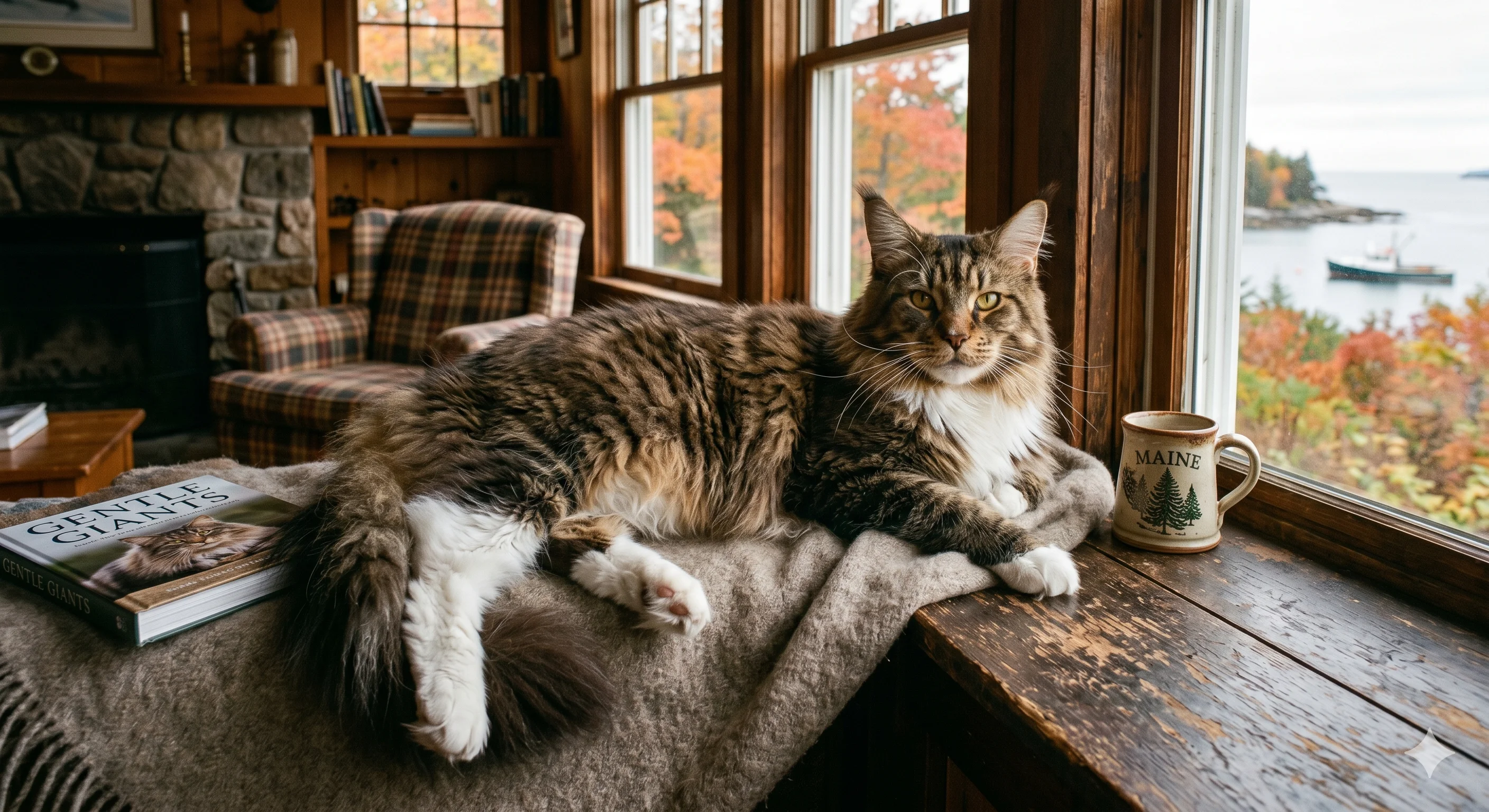
How big Maine Coons really get, when they stop growing, how they compare with Ragdolls, Norwegian Forest Cats and other large breeds, and which of the big cats you can legally own in Australia.
Ask anyone to name the biggest pet cat breed and most will say the Maine Coon. They are mostly right. For a cat you can actually buy, register and keep at home in Australia, the Maine Coon is the largest breed by overall length and among the heaviest. The full answer depends on how you measure "largest", and a few other breeds beat it on particular measurements.
Advertisement
This guide covers how big Maine Coons really get, how long they take to get there, how they compare with the other large breeds, and what living with a cat this size involves.
The short answer
- By length, the Maine Coon is the largest domestic breed. Many adults measure around a metre from nose to tail tip, and the Guinness record for the longest domestic cat has been held by Maine Coons.
- By weight, it is one of the heaviest breeds. Large males of other breeds, particularly Ragdolls, can match it on the scales.
- By height, early-generation Savannah cats (serval hybrids) stand taller. They are not an option in Australia, because Savannahs cannot be imported here.
So for Australian owners, the Maine Coon is the largest cat breed you can realistically own.
How "largest" is measured
"Big" can mean three different things, and breeds rank differently on each:
- Length is measured from the tip of the nose to the end of the tail, with the cat lying stretched out. This is where the Maine Coon stands out, thanks to its long body and long, full tail.
- Weight depends on bone, muscle and fat. A heavy cat isn't necessarily a large one. An overweight cat of an average breed can outweigh a lean Maine Coon without being any bigger in frame.
- Height is the measurement to the shoulder, and it comes mostly from leg length. Long-legged breeds stand taller even when they weigh less.
The Maine Coon also looks bigger than its measurements. The shaggy coat, thick ruff around the neck, tufted ears and plumed tail add bulk in every direction, so a Maine Coon and another cat of the same weight rarely look the same size.
How big do Maine Coons get?
Weight
Most adult male Maine Coons weigh 6–8 kg, and some well-built males from large lines reach 9 kg or more. Females are noticeably smaller, usually 4–6 kg. The difference between the sexes is bigger than in most breeds. If you want the largest possible cat, a male from a breeder with big, healthy parents is the most likely way to get one.
For comparison, a typical domestic cat weighs around 4 kg. A big male Maine Coon can be close to double that.
A healthy Maine Coon should feel solid and muscular, not soft. A breeder or vet can show you how to check body condition. If you can't feel the ribs under a thin layer of fat, the cat is probably carrying extra weight rather than extra size.
Length
Length is the Maine Coon's real claim to fame. Many adults measure around a metre from nose to tail tip, and typical cats fall somewhere between about 80 cm and 100 cm. The tail alone is often 35–40 cm. The body of an average domestic cat, not counting the tail, is around 46 cm long.
Growth: a slow-maturing breed
Maine Coons grow quickly in their first year. Many are already the size of an adult cat of another breed by the time they are a few months old. They then keep filling out slowly for years, and most are not fully grown until they are three to five years old. A two-year-old Maine Coon may still be adding muscle and length.
That long growth period matters for owners. A young Maine Coon needs good nutrition well past the age when other kittens stop growing, and it is too early at one or two years to judge how big your cat will end up. For feeding advice during that stage, see our guide to the best wet food for Maine Coon kittens.
Record holders
The Maine Coon's reputation owes a lot to a few exceptional cats:
- Stewie, a Maine Coon from Nevada, was recognised by Guinness World Records as the longest domestic cat, measuring 123 cm (48.5 inches) from nose to tail tip.
- Barivel, a Maine Coon in Italy, was later recognised as the longest living domestic cat at 120 cm.
These cats are outliers, not targets. Most Maine Coons will never come close, and a cat is no better for being bigger. Guinness World Records does not keep a heaviest-cat category, so that owners aren't encouraged to overfeed their pets.
How the Maine Coon compares with other large breeds
Ragdoll
The Ragdoll is the Maine Coon's closest rival on weight. Ragdolls are broad, heavy-boned cats, and a large male can weigh as much as a Maine Coon or more. They are usually shorter in the body, though, and their soft, semi-long coat lies flatter, so they tend to look dense and solid rather than long and rangy. They are also famously relaxed and often go limp when picked up. Our Ragdoll care guide covers the breed in detail.
Norwegian Forest Cat
The Norwegian Forest Cat looks a lot like a Maine Coon. Both developed in cold, harsh climates, both have thick, water-resistant coats, and some people believe they share ancestors. The Norwegian is similar in weight but usually more compact. It has a more triangular face, and its coat is denser and more even in length than the Maine Coon's shaggy layers. Individual cats vary enough that a large Norwegian can look bigger than a small Maine Coon. Read more in our Norwegian Forest Cat guide.
Siberian
Another cold-climate breed, the Siberian is powerful and muscular, with a dense triple coat. It is a solidly built, medium-to-large cat. Most Siberians are smaller and shorter than a typical Maine Coon, but they feel surprisingly heavy for their size.
Ragamuffin
Closely related to the Ragdoll, the Ragamuffin is a large, soft, long-coated cat with a similarly easy-going temperament. Like the Ragdoll, it is heavy for its length.
Persian
The Persian often appears on lists of big cats because its huge coat makes it look large. Underneath, it is a medium-sized cat with a short, cobby body. It is nowhere near a Maine Coon in length.
Savannah, Chausie and other hybrids
Advertisement
Early-generation Savannah cats, bred from domestic cats crossed with the African serval, can be very tall and long. On some measurements they beat the Maine Coon. The Chausie, a hybrid with the wild jungle cat, is also tall and lean.
In Australia this comparison is mostly theoretical. The Savannah cannot be imported into Australia, because of the risk a wild-cat hybrid could pose to native wildlife if it escaped. The same applies to other wild-cat hybrids. The Bengal is the main exception: it descends from the Asian leopard cat, but generations of domestic breeding separate today's Bengals from their wild ancestor. If you're unsure whether a breed is allowed, see our list of cats allowed in Australia.
What affects how big a Maine Coon gets
Genetics
Parentage is the best predictor. Kittens from large, well-built parents are much more likely to grow into large adults, although it isn't guaranteed. When you visit a breeder, it's reasonable to ask how big the parents are and, if possible, to meet them. Our page on Maine Coon kittens for sale covers what else to ask.
Nutrition
Good nutrition lets a kitten reach its genetic potential. Poor nutrition, especially in the first year, can hold growth back. Because Maine Coons keep developing for several years, a complete and balanced diet with plenty of animal protein matters well beyond kittenhood. Overfeeding does not make a bigger cat. It makes a fat one, with extra strain on the joints.
Health and activity
Regular play and climbing build muscle, and routine vet checks catch problems such as parasites or illness that can slow growth. A healthy, active young cat grows into its frame. An inactive one is more likely to put on fat.
Is a large size a problem?
Size and temperament are separate things. Maine Coons are known as gentle giants for good reason. They are usually calm, sociable and patient, and their size makes them confident rather than aggressive. Most respond to being startled with a chirp or trill rather than a swipe. Like any cat, they need gentle handling and good socialisation as kittens.
Size does matter in a few practical areas.
Health linked to size
- Hip dysplasia, an abnormally formed hip joint, is more noticeable in large, heavy cats and can lead to arthritis. Keeping your cat lean is the best protection.
- Hypertrophic cardiomyopathy (HCM), a thickening of the heart muscle, has a known genetic form in Maine Coons. Responsible breeders test for it.
- Spinal muscular atrophy (SMA) is an inherited condition that weakens the hind legs. A DNA test is available, and tested parents should not produce affected kittens.
Ask any breeder for the parents' test results. Our Maine Coon breed guide covers health in more detail.
Space and equipment
A big cat needs gear built for its size:
- Cat trees and scratching posts with heavy bases, wide platforms and thick posts. Light trees designed for small cats can wobble or tip. A post needs to be tall enough for a full stretch. See choosing a scratching post.
- An extra-large litter tray. Many standard trays are too small for an adult male to turn around in.
- A large, sturdy carrier. Some owners use a small dog crate.
- Beds and perches that let them stretch out fully.
Maine Coons can live happily in apartments if they have vertical space and daily play, but floor space and sturdy furniture help.
Running costs
Bigger cats eat more food. Some medications and parasite treatments are also dosed by weight, so a large cat can need the larger, more expensive product size. Budget for that, and consider pet insurance while your cat is young and healthy.
Heat
A heavy coat on a big body makes heat a real concern in an Australian summer. Keep a Maine Coon indoors and cool on hot days, provide plenty of water, and brush out the undercoat regularly. If your cat pants or seems flat in the heat, call your vet.
So, is the Maine Coon the largest?
For practical purposes, yes. It is the longest domestic breed, one of the heaviest, and the one that has held the record for the longest domestic cat. Ragdolls can match it on weight, and some hybrids stand taller, but no breed you can legally own in Australia combines size, length and an easy-going nature the way the Maine Coon does.
Frequently asked questions
What is the biggest cat breed you can own in Australia?
The Maine Coon. Ragdolls, Norwegian Forest Cats, Siberians and Ragamuffins are also large, but the Maine Coon is usually the longest and among the heaviest. Savannahs and other wild-cat hybrids cannot be imported into Australia.
How much does a fully grown Maine Coon weigh?
Most males weigh 6–8 kg and most females 4–6 kg. Some males from large lines reach 9 kg or more.
At what age is a Maine Coon fully grown?
Usually between three and five years. They grow fast in their first year, then keep filling out slowly.
Is a Ragdoll bigger than a Maine Coon?
Sometimes on weight, rarely on length. A large Ragdoll male can be as heavy as a Maine Coon, but Maine Coons are usually longer and look bigger because of their shaggy coat and long tail.
Are big cats harder to look after?
Not much, but they need sturdier furniture, a bigger litter tray and carrier, more food, and attention to weight and joint health. Long-haired large breeds also need regular brushing.
Which of the large breeds suits a family best?
Maine Coons, Ragdolls and Ragamuffins are all known for gentle, tolerant temperaments. Spend time with adult cats of each breed, and talk to registered breeders about your household, before choosing.
Advertisement