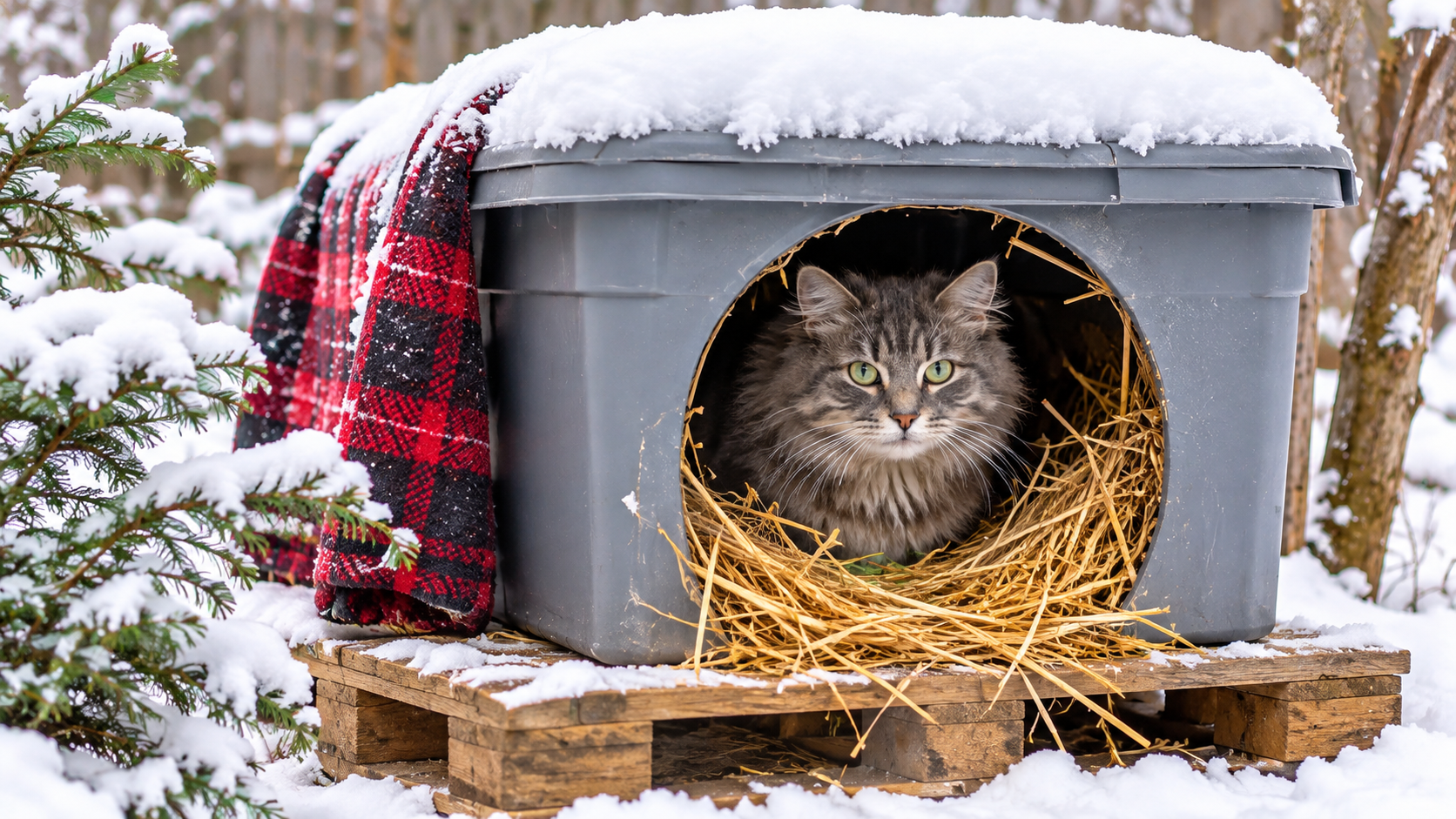
Build a warm, cheap winter shelter for outdoor and feral cats in under an hour. Step-by-step instructions, why straw beats blankets, and how to keep food and water from freezing.
When the temperature drops, outdoor cats face a dangerous few months. Community cats, ferals and strays have no warm home to return to, and a cold, wet night can be life-threatening, especially for kittens, older cats and cats that are already sick.
Advertisement
You don't need to be a builder to help. A simple insulated shelter made from a plastic storage tub, a foam cooler and a bale of straw can keep a small colony warm through the coldest nights. It takes under an hour, costs very little, and could save a life.
Below you'll find step-by-step instructions for the classic DIY winter cat shelter, the one bedding mistake almost everyone makes, where to place the shelter, how to stop food and water freezing, and other winter dangers for outdoor cats.
Quick answer
The easiest DIY winter cat shelter is a plastic storage tub with a foam cooler inside it, a small 15 to 20 cm (6 to 8 inch) entrance, and a thick layer of straw, never hay or blankets. Keep it small, raised off the ground, in a quiet spot, and clear snow from the entrance after storms. Provide extra food, ideally wet food, and use a heated or insulated water bowl to stop water freezing.
What makes a good winter cat shelter
Alley Cat Allies, a US advocacy organisation for community cats, gives these guidelines for an outdoor cat shelter:
| Feature | Recommendation | Why |
|---|---|---|
| Size | About 60 x 90 cm (2 x 3 ft) and 45 cm (18 inches) high | Small spaces hold heat better |
| Capacity | Room for three to five cats to huddle | Cats share body heat |
| Entrance | About 15 to 20 cm (6 to 8 inches) wide | Keeps out cold, wind and larger animals |
| Door flap | Optional flap over the entrance | Blocks snow, rain and wind |
| Bedding | Straw only | Stays dry and lets cats burrow |
| Location | Off the ground, in a quiet spot away from foot traffic | Avoids cold ground and disturbance |
Why smaller is better
It's tempting to build a roomy shelter, but bigger isn't better. Alley Cat Allies explains that heat disperses quickly in larger spaces. Kitsap Humane Society also advises choosing a smaller bin, since a big space loses heat faster. A compact shelter warmed by the cats' own body heat stays much cosier.
Straw, not hay or blankets: the most important rule
This is the mistake almost everyone makes. Blankets, towels and hay seem warm and cosy, but outdoors they can make a shelter colder and more dangerous.
Alley Cat Allies explains that:
- Hay soaks up moisture, which can make a shelter cold and mouldy.
- Straw repels moisture, so it stays dry and lets cats burrow in for warmth.
- A wet bed can be dangerous, making cats more likely to get sick.
Alley Cat Allies also advises avoiding blankets in outdoor shelters, because they hold moisture.
How to tell straw from hay
Alley Cat Allies says hay usually costs two or three times more than straw, and is heavier and green. Straw is lightweight and yellow or golden. You can buy straw from farm suppliers, garden centres, pet supply stores and local farmers.
How much straw to use
Alley Cat Allies recommends loosely packing straw to the quarter or halfway point of the shelter, and replacing it as the seasons change to keep it clean and dry. Store extra bales somewhere dry and off the ground.
How to build a DIY winter cat shelter
This is the classic storage tub and foam cooler design, based on instructions from Kitsap Humane Society.
What you'll need
- A plastic storage tub with a lid, about 45 cm (18 inches) long
- A polystyrene (Styrofoam) cooler that fits inside the tub
- Straw
- A craft knife or box cutter
- Duct tape
- Optional: a marker to trace the door, and a piece of flexible plastic for a door flap
Step-by-step instructions
- Choose the right size. Pick a small tub. Kitsap Humane Society notes that bigger is not always better, since heat disperses more quickly in larger spaces.
- Mark the entrance. Trace a circle or square about 15 to 20 cm (6 to 8 inches) wide on one end of the tub, a few centimetres above the base so straw doesn't spill out.
- Cut the entrance. Carefully cut the opening with a craft knife. Keep it only large enough for a cat to pass through.
- Insert the cooler. Place the foam cooler inside the tub as insulation.
- Cut a matching hole in the cooler. Line it up with the tub's entrance so cats can walk straight in.
- Add straw. Pack straw inside the cooler, and in any gaps between the cooler and the tub. Kitsap Humane Society suggests filling it as much as possible for insulation, while leaving room for cats to burrow in.
- Seal the lids. Tape the cooler's lid in place, then put on the tub's lid and tape it down to keep out wind and water.
- Add a door flap (optional). Tape a piece of flexible plastic over the top of the entrance to block wind and snow while still letting cats push through.
- Make it inviting. Kitsap Humane Society suggests adding a little catnip or a few treats inside.
Other DIY designs
- Two-door shelter: Some caretakers add a second, escape exit, so a cat can't be trapped inside by another animal. Place the doors on opposite sides, and protect both from the wind.
- Wooden shelter: A small insulated wooden box with a sloped roof lasts for years, but takes more time and tools to build.
- Foam-lined crate: A sturdy plastic pet carrier lined with foam board and filled with straw works in a pinch.
Where to put the shelter
Placement can make the difference between a shelter cats use and one they ignore.
- Off the ground. Alley Cat Allies recommends setting the shelter up off the ground. The Animal Welfare Association of New Jersey suggests raising shelters on wooden pallets with insulation.
- In a quiet spot. Choose a discreet location away from foot traffic, as Alley Cat Allies and the Animal Welfare Association recommend.
- Protected from wind. Face the entrance away from the prevailing wind, or toward a wall or fence a short distance away.
- Camouflaged. Kitsap Humane Society suggests using leaves or branches around the shelter to help it blend in.
- On level ground, so it doesn't tip or fill with water.
After snow and storms
Kitsap Humane Society advises checking shelters regularly, especially after snowstorms, because snow can pile up and trap a cat inside. Alley Cat Allies recommends shovelling out shelters when you clear your own driveway, keeping entrances clear, and making a path for cats hiding under bushes or porches.
Food and water in winter
Feed a little more
The Animal Welfare Association of New Jersey explains that extreme cold weather can increase a cat's energy and nutritional needs, so outdoor cats may need more food in winter.
It also recommends wet food for cold-weather feeding, because it takes less energy to digest, leaving more energy for staying warm. Serve wet food in insulated containers so it doesn't freeze as quickly. In very cold weather, you can feed wet food more often in smaller amounts.
Advertisement
Keep water from freezing
Frozen water bowls are a real problem for outdoor cats. Some options:
- Heated pet water bowls designed for outdoor use
- Insulated or deep bowls, which freeze more slowly than shallow dishes
- A double-bowl setup: the Animal Welfare Association of New Jersey describes placing a heater in a large, tip-proof bowl of water with a smaller water bowl set on top, similar to a double boiler
- Fresh water more often, ideally morning and evening
Always use outdoor-rated, pet-safe heated products, and check cords regularly for damage.
Build a feeding station
A simple roof over the food and water bowls, such as a large tub on its side, keeps snow and rain out. Place it near, but not right beside, the shelter, so food smells don't attract other animals into the sleeping area.
Other winter dangers for outdoor cats
Car engines
Cats often crawl into warm engines or hide under cars. Alley Cat Allies recommends giving the hood a tap and checking between the tyres before you start your car.
Antifreeze
Antifreeze is extremely dangerous. Pet Poison Helpline warns that as little as one teaspoon of antifreeze can be fatal to a cat, and that cats must be treated within about three hours to give treatment the best chance of working. Signs can look like drunkenness at first, including stumbling, drooling and vomiting, followed by kidney failure.
Alley Cat Allies advises keeping antifreeze out of reach and cleaning up spills immediately. If you suspect a cat has swallowed antifreeze, contact an emergency vet straight away. In the US, you can also call Pet Poison Helpline on (855) 764-7661 or the ASPCA Animal Poison Control Center on (888) 426-4435.
De-icing salt
Alley Cat Allies recommends avoiding salt and chemical ice melters, which can be toxic to animals and harm their paws. The Animal Welfare Association of New Jersey also advises avoiding de-icing salts and chemicals near cat colonies.
Frostbite and hypothermia
Ear tips, tails and paws are most at risk. Signs of cold injury include pale or grey skin, swelling, shivering, weakness and lethargy. A cat showing these signs needs to be warmed gently and seen by a vet.
How to help outdoor cats beyond winter
- Support trap-neuter-return (TNR) programs, which aim to reduce the number of cats living outdoors over time.
- Help friendly strays find homes. Check for a microchip at a vet clinic, and contact local rescue groups.
- Bring kittens and sick cats inside if you can, and contact a rescue group for support.
- Talk to neighbours so they know about the shelter and don't disturb it.
For pet cats
Pet cats are safest indoors, especially in winter. If your own cat goes outside, keep it in at night and during freezing weather. In many parts of Australia, councils require cats to be contained. Our guide to cat laws in Australia explains the rules. A secure outdoor enclosure lets cats enjoy fresh air safely. See our guide to cat enclosures and catios.
Winter outdoor cat checklist
- [ ] The shelter is small, insulated and raised off the ground.
- [ ] The entrance is 15 to 20 cm wide, facing away from the wind.
- [ ] Bedding is straw, not hay, blankets or towels.
- [ ] I check the shelter after every storm and clear snow from the entrance.
- [ ] Cats get extra food, ideally wet food, in insulated bowls.
- [ ] Water is protected from freezing.
- [ ] I tap the car hood before starting the engine.
- [ ] Antifreeze is stored safely and spills are cleaned up.
- [ ] I avoid salt and chemical ice melters near the colony.
- [ ] I know the nearest emergency vet.
Frequently asked questions
How do I keep outdoor cats warm in winter?
Give them a small, insulated shelter filled with straw, raised off the ground and placed in a quiet spot. Provide extra food, ideally wet food, and keep their water from freezing. Clear snow from shelter entrances after storms.
Should I put blankets in a cat shelter?
No. Alley Cat Allies advises against blankets and hay because they hold moisture, which can make a shelter cold and mouldy. Use straw, which repels moisture and lets cats burrow in.
How big should a winter cat shelter be?
Alley Cat Allies recommends about 60 x 90 cm (2 x 3 feet) and 45 cm (18 inches) high, with room for three to five cats. Smaller shelters stay warmer because heat disperses quickly in larger spaces.
How big should the door be?
About 15 to 20 cm (6 to 8 inches) wide. That's big enough for a cat but small enough to keep out cold air, wind and larger animals.
What is the cheapest way to make a cat shelter?
A plastic storage tub with a polystyrene cooler inside and a thick layer of straw is one of the cheapest and most effective designs. It takes under an hour to build.
How do I stop outdoor cats' water from freezing?
Use a heated outdoor pet bowl, a deep or insulated bowl, or a double-bowl setup with a heater underneath. Refresh water at least twice a day in freezing weather.
Is antifreeze dangerous to cats?
Yes, extremely. Pet Poison Helpline warns that as little as one teaspoon can be fatal to a cat. Clean up spills immediately and contact an emergency vet straight away if you suspect a cat has swallowed any.
Related guides
Sources
- Alley Cat Allies, Outdoor cat cold weather tips
- Alley Cat Allies, Straw, not hay, for outdoor cat shelters
- Kitsap Humane Society, How to make a winter shelter for community cats
- Animal Welfare Association of New Jersey, Caring for feral cats in winter
- Pet Poison Helpline, Antifreeze poisoning in dogs and cats
This guide is general information only and is not a substitute for advice from your vet. If an outdoor cat seems sick or injured, contact a vet or local rescue group.
Advertisement