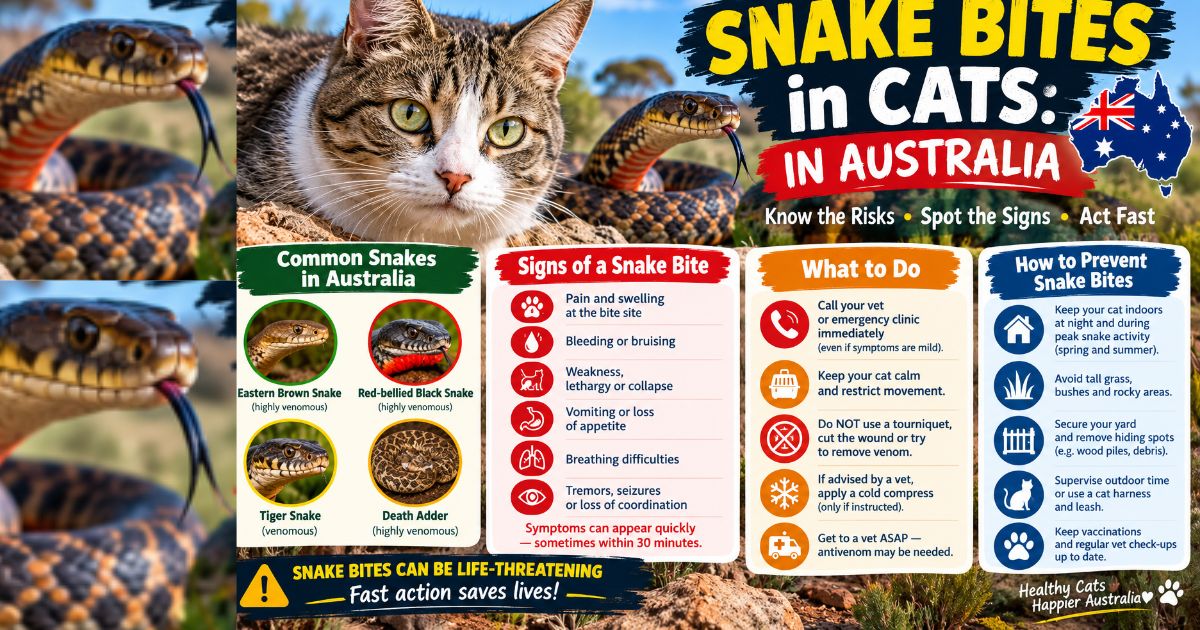
Snakes are active again as the weather warms. Learn the signs of a snake bite in cats, what to do on the way to the vet, how bites are treated and how to keep your cat safe.
As the weather warms up, snakes become more active, and so do curious cats. Australia is home to some of the most venomous snakes in the world, and every year vets treat cats that have been bitten in backyards, on farms and on the edge of bushland.
Advertisement
The good news is that cats survive snake bites more often than dogs, especially when they reach a vet quickly. The hard part is that cats often hide when they feel unwell, so a bite can be easy to miss.
This guide covers the signs of snake bite in cats, what to do (and not do) on the way to the vet, how vets treat bites, what the research says about survival, and how to keep your cat safer through snake season.
How common are snake bites in pets?
A survey of Australian vets published in the Australian Veterinary Journal estimated that around 6,200 pets are treated for snake bite in Australia each year, with cats and dogs the most common victims. Most bites in that survey happened in rural areas (78%), but almost a quarter (22%) were in urban areas, so suburban cats aren't immune.
The same survey found that brown snakes were responsible for most bites (76% of cases), followed by tiger snakes and black snakes.
When is snake season?
Snakes are cold-blooded and become much more active when it is warm. RSPCA NSW advises pet owners to take particular care in the summer months, and the RSPCA's knowledge base notes that snakes become more active as the weather warms. In practice, that means spring through to autumn in most of Australia, with the risk highest on warm, sunny days.
Which snakes bite cats?
The snakes that cause the most trouble for pets vary by region, but the main culprits in Australia include:
- Brown snakes (Pseudonaja species), including the eastern brown snake. These are responsible for the majority of pet bites.
- Tiger snakes, common in southern and coastal areas.
- Black snakes, including the red-bellied black snake.
RSPCA Australia notes that tiger and brown snake bites commonly cause paralysis, muscle weakness and problems with blood clotting.
You don't need to know which snake it was to get help. Vets can run a test to work out which antivenom is needed. Never try to catch or kill a snake to identify it.
Why cats get bitten
Cats are natural hunters. Many cats will stalk, bat at or play with a snake rather than run from it, which puts their face and front legs close to the snake's head. That is why many bites happen on the face, neck and front legs.
Because cats are small and often roam out of sight, owners frequently don't see the bite happen. A cat may simply come home quiet, hide under a bed or seem "off".
Signs of snake bite in cats
Signs can appear within minutes or develop over several hours, depending on the snake, the amount of venom and where the bite is. RSPCA Australia lists these common signs in pets:
- Sudden weakness followed by collapse, sometimes followed by what looks like a recovery
- Muscle shaking or twitching, and reduced blinking
- Vomiting
- Loss of bladder or bowel control
- Dilated (enlarged) pupils
- Paralysis
- Difficult or rapid breathing
- Bleeding from the nose, mouth or bite site
- Dark, often bloody, urine
- Not eating, which RSPCA Australia notes is especially common in cats
The "collapse and recovery" trap
One of the most dangerous patterns is a pet that collapses, then seems to bounce back. RSPCA Australia lists this as a common sign of snake bite. An apparent recovery does not mean the danger has passed: venom can keep working, and paralysis or bleeding problems can follow later.
Subtle signs in cats
Cats are good at hiding illness. In a cat that lives in a snake area, take these seriously, especially on a warm day:
- Hiding, unusual quietness or not wanting to be touched
- Wobbly walking or weakness in the back legs
- Wide pupils that don't shrink in bright light
- Not eating
- Drooling or vomiting
- A swollen face, paw or leg, or a small puncture wound
If your cat shows any of these signs and you can't explain them, call your vet. It is far better to be checked and told it isn't a snake bite than to wait.
What to do if you think your cat has been bitten
RSPCA Australia and RSPCA NSW give similar advice. The most important step is speed: the chances of recovery are much greater if your pet is treated early.
- Keep your cat calm and still. Movement helps venom spread. Carry your cat rather than letting it walk, ideally in a carrier or wrapped in a towel.
- Call your vet or the nearest emergency hospital and tell them you're on your way with a suspected snake bite, so they can prepare.
- Get to the vet straight away. Even if your cat seems to have recovered, or you're not sure it was a snake.
- Apply a pressure bandage if you can do it quickly and safely. RSPCA Australia advises a firm bandage above, over and below the bite site if you can find it. Only do this if it won't delay getting to the vet, and stop if it is distressing your cat.
- Remove the collar if the bite is on the face or neck, in case of swelling.
- Note what the snake looked like from a safe distance, or take a photo only if it is completely safe. This can help, but it isn't essential.
What NOT to do
According to the RSPCA:
- Don't wash the wound.
- Don't apply a tourniquet.
- Don't try to catch or kill the snake.
- Don't touch the snake, even if it looks dead.
Also avoid waiting to "see how they go". Snake bite is one emergency where waiting can cost your cat its life.
How vets treat snake bite in cats
Treatment depends on how unwell your cat is and what type of snake was involved. It may include some or all of the following.
Confirming the bite and the snake type
RSPCA NSW notes that vets can run a blood or urine test to confirm a bite and identify the type of snake. This helps the vet choose the right antivenom.
Antivenom
Antivenom is the main treatment for snake bite. It neutralises venom that is still circulating in the body. Because the venom causes damage over time, the earlier antivenom is given, the better.
Supportive care
Depending on the case, your cat may also need:
- Intravenous fluids
- Oxygen therapy
- Blood or plasma transfusions if clotting has been affected
- Mechanical ventilation (a breathing machine) in severe cases where the breathing muscles are paralysed
- Close monitoring in hospital for a day or more
RSPCA Australia notes that severe cases may need intensive care, and that treatment can be expensive. If you live in a snake-prone area, it is worth checking whether your pet insurance covers snake bite, and knowing where your nearest 24-hour emergency vet is.
Do cats survive snake bites?
Many do, especially with prompt treatment.
The Australian vet survey mentioned earlier recorded these survival rates:
| Cats | Dogs | |
|---|---|---|
| Treated with antivenom | 91% | 75% |
| Not treated with antivenom | 66% | 31% |
Advertisement
Research led by the University of Queensland, published in 2020 in Comparative Biochemistry and Physiology, looked at why cats seem to cope better. The team found that brown snake venom made dog blood clot much faster than cat blood. Dogs' blood also clotted more quickly on its own. This suggests dogs are more vulnerable to the clotting effects of these venoms, which may help explain why cats survive more often.
Survival is not guaranteed, though. A third of untreated cats in the survey died, and the figures above are averages: a large dose of venom, a bite from a highly venomous snake or a long delay before treatment can all make the outcome worse. The single biggest thing you can do is get your cat to a vet fast.
Recovery at home
Most cats that recover from snake bite need some time to get back to normal. Your vet will give you specific instructions, but recovery often involves:
- Keeping your cat indoors and quiet while it regains strength
- Watching that it eats, drinks, urinates and passes stools normally
- Checking the bite area for swelling or infection
- Returning for any follow-up checks your vet recommends
Call your vet straight away if your cat becomes weak again, has trouble breathing, bleeds from anywhere or passes dark urine.
How to protect your cat from snakes
You can't remove every snake from the environment, but you can greatly reduce the risk.
Keep your cat indoors or contained
The most effective step is limiting your cat's chances of meeting a snake. Indoor cats, and cats that go outside only in a secure enclosure, are much less likely to be bitten. Containment also protects your cat from cars, fights and paralysis ticks, and protects native wildlife.
If you'd like your cat to enjoy outdoor time safely, see our guide to cat enclosures and catios. Make sure the mesh is fine enough, and that there are no gaps at ground level that a snake could squeeze through.
Some parts of Australia now require cats to be contained. Our guide to cat laws in Australia explains the rules where you live.
Make your yard less inviting to snakes
RSPCA NSW recommends keeping grass short and clearing away places where snakes could hide. Practical steps include:
- Mow lawns regularly and trim long grass along fences.
- Clear piles of timber, rubbish, sheets of iron and garden waste.
- Keep compost and bird seed areas tidy, since they attract the rodents that snakes hunt.
- Seal gaps under doors, sheds and decks where possible.
Be extra careful on warm days
Keep your cat inside during the warmest parts of spring and summer days if you live near bushland, creeks or farmland. If you see a snake in your yard, bring your pets inside and call a licensed snake catcher. Never try to move or kill a snake yourself; it is dangerous and, in many states, illegal because native snakes are protected.
Know your local snakes and emergency vet
RSPCA Australia suggests learning which venomous snakes live in your area and in places you visit. Save the number of your nearest 24-hour emergency vet in your phone before snake season starts.
Snake bite checklist for cat owners
- [ ] Keep your cat indoors or in a secure enclosure, especially on warm days.
- [ ] Keep grass short and clear hiding spots around your home.
- [ ] Save your nearest 24-hour emergency vet's number in your phone.
- [ ] Keep a pet carrier and a firm bandage somewhere easy to reach.
- [ ] If you suspect a bite: keep your cat still, call ahead and go to the vet immediately.
- [ ] Don't wash the wound, don't use a tourniquet and don't chase the snake.
- [ ] Don't wait for signs to get worse, even if your cat seems to recover.
Frequently asked questions
How long after a snake bite do signs appear in cats?
It varies. Some cats collapse within minutes, while others show signs over several hours. Some cats seem to recover after an initial collapse before getting worse. If you think your cat may have been bitten, see a vet straight away rather than waiting for signs.
Can a cat survive a snake bite without treatment?
Some do. In the Australian vet survey, 66% of cats that didn't receive antivenom survived, compared with 31% of dogs. But that also means about a third of untreated cats died. Treatment greatly improves the odds, so don't take the risk.
Are cats immune to snake venom?
No. Cats are more likely than dogs to survive bites from some Australian snakes, but they are not immune. Snake bite can and does kill cats.
What if I didn't see a snake?
Most owners don't. If your cat suddenly becomes weak, wobbly, collapses, has enlarged pupils or bleeds without a clear reason, especially on a warm day, tell your vet a snake bite is possible. Vets can test for it.
Does pet insurance cover snake bite?
Many pet insurance policies cover accidents such as snake bite, but cover varies. Check your policy's accident cover, waiting periods and limits before snake season.
Should I bring the snake to the vet?
No. Don't try to catch or kill the snake, and don't touch one even if it appears dead. Vets can identify the type of venom with a test.
Related guides
- Paralysis ticks in cats: another warm-weather emergency for cats on the east coast.
- How to tell if your cat is sick: subtle signs cats hide, and when to see a vet.
Sources
- RSPCA Australia Knowledgebase, My pet has been bitten by a snake, what should I do?
- RSPCA NSW, Snake bites and pets
- Mirtschin PJ, Masci P, Paton DC, Kuchel T (1998). Snake bites recorded by veterinary practices in Australia. Australian Veterinary Journal 76(3): 195–198.
- Zdenek CN, Fry BG et al. (2020). Pets in peril: the relative susceptibility of cats and dogs to procoagulant snake venoms. Comparative Biochemistry and Physiology Part C 236: 108769.
- RACQ, Cats more likely to survive snake bites than dogs
This guide is general information only and is not a substitute for advice from your vet. If you think your cat has been bitten by a snake, contact a vet immediately.
Advertisement