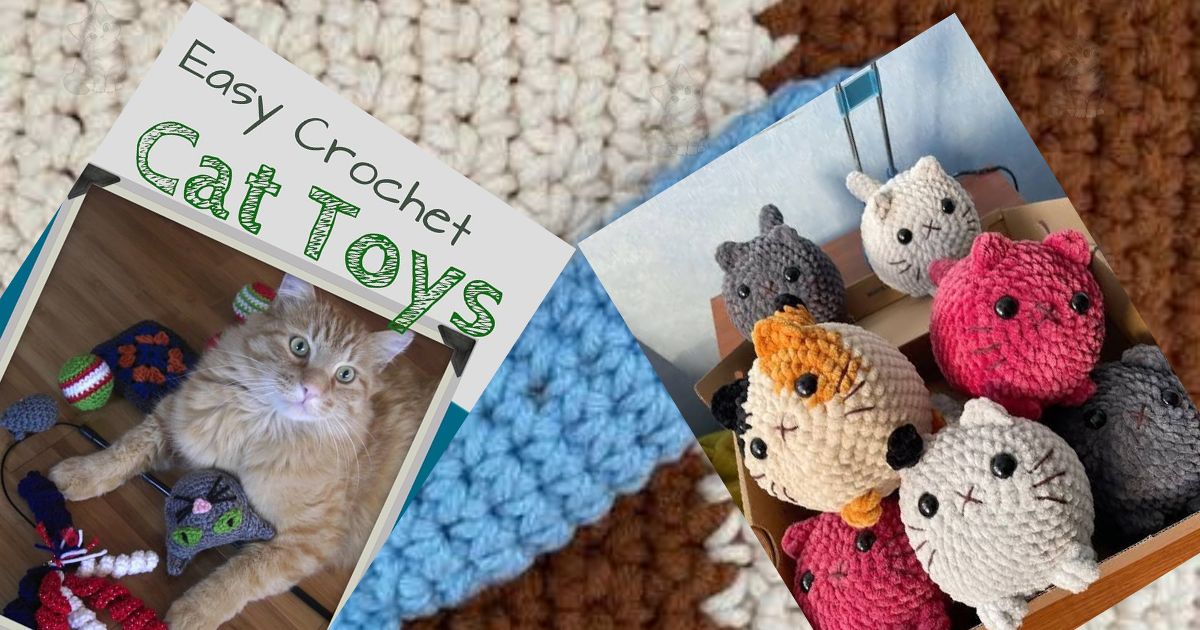
Three free, beginner-friendly crochet cat toy patterns: a catnip mouse, a catnip ball and a fish kicker. Plus the yarn safety rules every crocheter with a cat needs to know.
If you crochet and share your home with a cat, you already know the struggle. The moment your yarn comes out, your cat appears, ready to pounce. So why not turn that enthusiasm into something useful, and crochet toys made especially for your cat?
Advertisement
Crochet cat toys are quick, cheap and a great way to use up leftover yarn. A catnip mouse takes less than an hour, and you can make a whole basket of toys from a single ball of cotton.
There's one thing most crochet patterns don't mention, though: yarn and string can be dangerous for cats. Below you'll find three free, beginner-friendly patterns designed with cat safety in mind, the materials to use and avoid, and the safety rules every crocheter with a cat should know.
Quick overview
| Pattern | Skill level | Time | Best for |
|---|---|---|---|
| Catnip mouse | Beginner | About 45 minutes | Batting, carrying and chasing |
| Catnip ball | Beginner | About 30 minutes | Rolling and pouncing |
| Fish kicker | Advanced beginner | About 2 hours | Bunny-kicking and wrestling |
All three patterns are worked in the round using single crochet, increases and decreases. If you can make a magic ring and single crochet, you can make all three.
Before you start: yarn safety for cats
Why yarn can be dangerous
Cats love playing with string, but swallowing it can cause a serious emergency. VCA Animal Hospitals explains that when string or yarn is swallowed, one end can lodge in the digestive tract while the rest trails through the intestines. The intestines bunch up along it, and it can saw through the intestinal wall. VCA describes intestinal tearing as the most significant complication, which can lead to life-threatening infection.
VCA lists the most common signs as vomiting, refusing to eat, dehydration and lethargy. Treatment usually requires surgery.
If you ever see yarn or string hanging from your cat's mouth or bottom, don't pull it. UK vet Yvette Bell, writing for Vet Help Direct, explains that pulling can cut into the intestinal wall. Contact your vet or an emergency vet straight away.
Safety rules for crochet cat toys
- No long tails, tassels or dangling strings. These are the parts cats chew off and swallow. Our mouse pattern has no tail for this reason.
- No safety eyes, buttons, beads or sequins. These can be chewed off and swallowed.
- Weave in every yarn end securely. Weave each end back and forth through several stitches in different directions, then trim it close.
- Crochet tightly. Use a hook a little smaller than the yarn label suggests, so stuffing and catnip can't escape and claws can't pull stitches apart.
- Choose 100% cotton yarn. It's durable, washable and doesn't shed fluffy fibres like some acrylics and novelty yarns.
- Supervise play with any yarn toy, especially at first.
- Check toys often and throw away any toy with loose stitches, holes or fraying.
- Store toys and your yarn stash away when you're not around. A cat left alone with a ball of yarn is the most common way string ends up swallowed.
Materials you'll need
- Yarn: 100% cotton, worsted or aran weight (8 or 10 ply in Australia). Small amounts are enough. Each toy uses roughly 10 to 30 g.
- Hook: 3.5 mm or 4 mm (US E-4 or G-6). Go smaller than the yarn label suggests for tight stitches.
- Stuffing: polyester fibrefill, or offcuts of the same cotton yarn for a firmer toy.
- Dried catnip or silver vine (optional).
- Stitch marker to mark the start of each round.
- Yarn needle to weave in ends.
- Scissors.
Crochet terms: US vs UK (Australia)
Australia usually uses UK crochet terms, while most online patterns use US terms. These patterns are written in US terms, with UK equivalents below.
| Abbreviation (US) | US term | UK/Australian term |
|---|---|---|
| MR | Magic ring | Magic ring |
| ch | Chain | Chain |
| sl st | Slip stitch | Slip stitch |
| sc | Single crochet | Double crochet (dc) |
| inc | Increase: 2 sc in the same stitch | 2 dc in the same stitch |
| dec | Decrease: sc 2 stitches together | dc 2 stitches together |
| (…) x3 | Repeat the instructions in brackets 3 times | Same |
| (12) | Total stitches at the end of the round | Same |
All three patterns are worked in continuous spirals. Don't join rounds with a slip stitch. Place a stitch marker in the first stitch of each round and move it up as you go.
Pattern 1: Catnip mouse
A classic cat toy that's small enough to carry, bat around and toss in the air. This version has no tail and no string, for safety.
Finished size: about 7 cm long.
Body
- Round 1: MR, 6 sc in the ring, pull tight. (6)
- Round 2: (sc 1, inc) x3. (9)
- Round 3: (sc 2, inc) x3. (12)
- Round 4: (sc 3, inc) x3. (15)
- Round 5: (sc 4, inc) x3. (18)
- Rounds 6 to 10: sc in each stitch around. (18)
- Round 11: (sc 4, dec) x3. (15)
- Round 12: (sc 3, dec) x3. (12)
- Round 13: (sc 2, dec) x3. (9)
Stuff the body firmly, adding a pinch of catnip in the centre of the stuffing.
- Round 14: (sc 1, dec) x3. (6)
Fasten off, leaving a 20 cm tail. Thread it through the front loops of the last 6 stitches, pull tight to close, then weave the end securely through the body in several directions and trim it close.
Ears (make 2)
- Round 1: MR, 6 sc in the ring, pull tight. (6)
- Sl st into the first stitch to finish. Fasten off, leaving a 15 cm tail.
Sew the flat ears onto the narrower end of the body, between Rounds 3 and 5, with several small, tight stitches. Weave the ends deep into the body and trim them close.
Optional: Instead of embroidered eyes, which can come loose, leave the face plain. Cats don't mind!
Pattern 2: Catnip ball
A simple, sturdy ball that rolls across the floor and invites pouncing. Make a few in different colours.
Finished size: about 6 cm across.
- Round 1: MR, 6 sc in the ring, pull tight. (6)
- Round 2: inc in each stitch around. (12)
- Round 3: (sc 1, inc) x6. (18)
- Round 4: (sc 2, inc) x6. (24)
- Rounds 5 to 8: sc in each stitch around. (24)
- Round 9: (sc 2, dec) x6. (18)
- Round 10: (sc 1, dec) x6. (12)
Stuff firmly, with a teaspoon of catnip wrapped in the centre of the stuffing.
- Round 11: dec x6. (6)
Fasten off. Close the opening by threading the yarn through the front loops of the last 6 stitches and pulling tight. Weave the end securely back and forth through the ball and trim it close.
Variations
- Crinkle ball: Skip the catnip and add a small ball of stuffing only. Some owners add crinkle material, but avoid anything your cat could chew out and swallow.
- Bell ball: Bells are a choking hazard if a toy is torn open. If you add one, use a large bell enclosed in a sealed plastic capsule, and check the toy often.
- Stripes: Change colour every two rounds for a striped ball.
Advertisement
Pattern 3: Fish kicker
Kicker toys are long enough for a cat to hug with its front paws and "bunny kick" with its back legs, which is a natural hunting behaviour. This fish-shaped kicker is a great outlet for energetic cats.
Finished size: about 22 to 25 cm long, depending on yarn and tension.
Body
Start at the fish's mouth.
- Round 1: MR, 6 sc in the ring, pull tight. (6)
- Round 2: (sc 1, inc) x3. (9)
- Round 3: (sc 2, inc) x3. (12)
- Round 4: (sc 3, inc) x3. (15)
- Round 5: (sc 4, inc) x3. (18)
- Round 6: (sc 5, inc) x3. (21)
- Round 7: (sc 6, inc) x3. (24)
- Rounds 8 to 25: sc in each stitch around. (24)
Stuff the body as you go, keeping it firm. Add catnip throughout the middle of the stuffing.
- Round 26: (sc 2, dec) x6. (18)
- Round 27: (sc 1, dec) x6. (12)
Finish stuffing. Flatten the opening so the stitches line up in two layers of 6.
- Join: Ch 1, then sc through both layers across the opening to close it. (6)
Tail fin
Now work back and forth in rows to make the tail fin.
- Row 1: Ch 1, turn. Inc in each stitch across. (12)
- Row 2: Ch 1, turn. (sc 1, inc) x6. (18)
- Row 3: Ch 1, turn. sc in each stitch across. (18)
Fasten off. Weave all ends in securely in several directions and trim them close.
Optional fins
Make two small side fins for extra texture:
- Round 1: MR, 6 sc in the ring, pull tight. (6)
- Sl st to finish. Fasten off and sew flat onto each side of the body, about a third of the way from the mouth, with small, tight stitches.
Catnip, silver vine and alternatives
Not every cat goes wild for catnip. A study by Bol and colleagues, published in BMC Veterinary Research in 2017, tested 100 domestic cats and found that about one in three cats didn't respond to catnip.
The same study found other plants that many cats enjoy:
| Plant | Share of cats that responded |
|---|---|
| Silver vine | 79% |
| Tatarian honeysuckle | 53% |
| Valerian root | 47% |
If your cat ignores catnip, try stuffing your toys with dried silver vine instead. You can also refresh an old toy by storing it in a sealed container with a little dried catnip or silver vine for a day or two.
How to keep crochet cat toys fresh and safe
- Rotate toys. Bring out two or three at a time and swap them every few days to keep your cat interested.
- Wash toys by hand in warm water with mild soap, then let them dry completely. Cotton toys usually wash well. Refresh the catnip afterwards.
- Inspect toys weekly for loose stitches, holes or fraying ends.
- Throw out damaged toys. It's not worth repairing a toy your cat has chewed open.
- Never leave your yarn stash out. Store balls of yarn and works in progress in a closed bag or box.
For more ways to keep indoor cats active, see our guide to choosing the best cat scratching post.
Why homemade toys are good for indoor cats
Play is more than fun. Agriculture Victoria explains that indoor cats need enrichment, including opportunities to play and express natural behaviours like stalking and pouncing. Short daily play sessions with toys like these help burn energy, reduce boredom and strengthen the bond between you and your cat.
Many Australian councils now require cats to be kept contained, so indoor enrichment matters more than ever. Our guide to cat laws in Australia explains the rules where you live.
Crochet cat toy safety checklist
- [ ] I'm using 100% cotton yarn.
- [ ] I've crocheted tightly so stuffing can't escape.
- [ ] My toy has no long tails, tassels, strings, buttons or safety eyes.
- [ ] Every yarn end is woven in securely and trimmed close.
- [ ] I supervise my cat's play with yarn toys.
- [ ] I check toys every week for damage.
- [ ] I throw out damaged toys straight away.
- [ ] My yarn stash is stored away from my cat.
- [ ] I know not to pull on string if my cat swallows some, and to call a vet.
Frequently asked questions
Are crochet toys safe for cats?
They can be, if they're made carefully. Use cotton yarn, crochet tightly, avoid strings, tassels and safety eyes, and weave in every end. Supervise play and throw away damaged toys, since swallowed yarn can cause serious intestinal injury.
What is the best yarn for crochet cat toys?
100% cotton is the best choice. It's durable, washable and doesn't shed fluffy fibres. Avoid novelty yarns, eyelash yarns and loosely spun yarns that cats can easily pull apart.
What should I do if my cat swallows yarn?
Don't pull on any yarn hanging from your cat's mouth or bottom. Contact your vet or an emergency vet straight away. VCA Animal Hospitals says swallowed string usually needs surgery, and signs include vomiting, not eating and lethargy.
Can I put catnip in crochet toys?
Yes. Place dried catnip in the centre of the stuffing so it stays inside the toy. About one in three cats don't respond to catnip, according to a 2017 study, so try silver vine if your cat isn't interested.
Are these patterns in US or UK terms?
They're written in US terms. In UK and Australian terms, single crochet (sc) is called double crochet (dc). The table above shows all the conversions.
How do I stop my cat playing with my yarn while I crochet?
Give your cat its own crochet toy to play with, keep your yarn in a closed bag or yarn bowl, and put everything away when you finish. Never leave yarn out when your cat is alone.
Related guides
- Best cat scratching posts and what cats prefer
- How to tell if your cat is sick
- Cat laws in Australia by state
Sources
- VCA Animal Hospitals, Foreign body in cats
- Vet Help Direct, My cat's swallowed some string, should I pull it out?
- Bol S et al., Responsiveness of cats to silver vine, Tatarian honeysuckle, valerian root and catnip, BMC Veterinary Research, 2017
- Agriculture Victoria, Creating the perfect indoor haven
These patterns are original designs by InfoDogCats and free for personal use. Safety information is general only and not a substitute for advice from your vet.
Advertisement