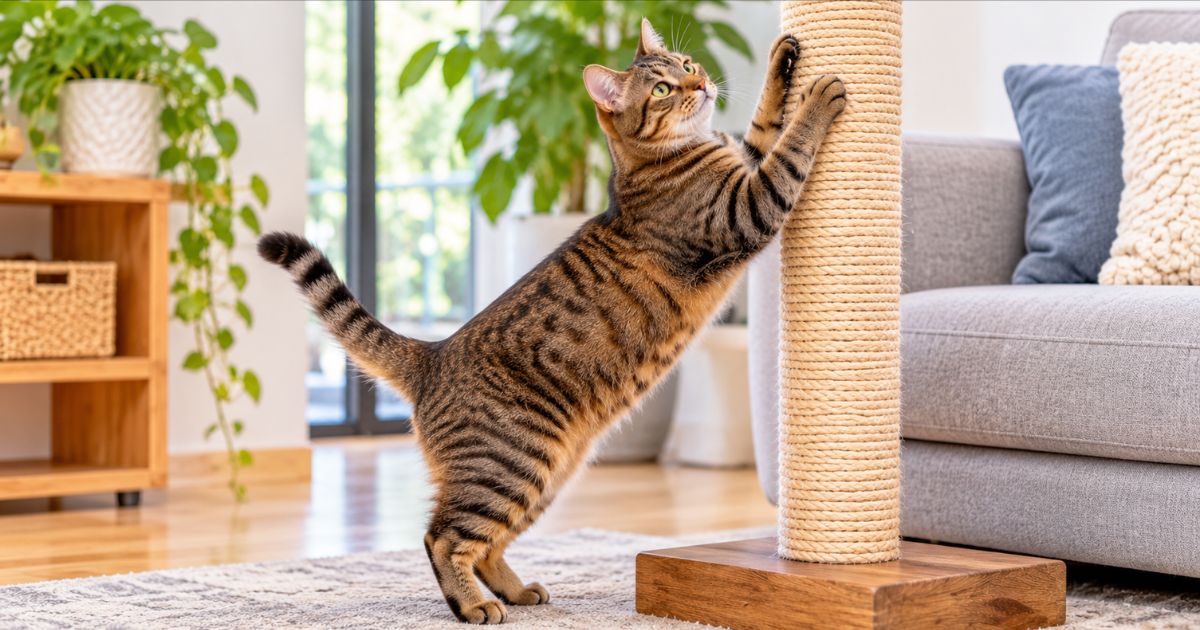
Not all scratching posts are equal. What research says cats prefer, the features that make a post worth buying, and how to get your cat using it instead of your couch.
If your cat is shredding the couch, the carpet or the side of your bed, you're not alone. Scratching is one of the most common complaints cat owners have. The good news is that it's usually easy to fix with the right scratching post in the right place.
Advertisement
The problem is that many scratching posts sold in shops are too short, too wobbly or covered in the wrong material, so cats ignore them and go back to the furniture.
Below you'll find why cats scratch, what research says cats actually prefer, the features to look for in a scratching post, where to put it, and how to train your cat to use it.
Quick answer: what makes the best cat scratching post?
The best scratching post is:
- Tall enough for your cat to scratch at full stretch
- Heavy and stable, so it doesn't wobble or tip over
- Covered in sisal rope or sisal fabric, a material many cats prefer
- Vertical, for most cats, with a horizontal scratcher as well for cats that scratch carpets or rugs
- Placed where your cat already scratches, near its bed and in the main living area
Why do cats scratch?
Scratching is a normal, healthy behaviour, not bad behaviour. Agriculture Victoria explains that cats scratch to:
- Sharpen and maintain their claws, shedding the old outer layer
- Stretch their back, shoulders and legs
- Relieve stress
- Mark their territory, using both visible scratch marks and scent from glands in their paws
Because scratching is a natural need, you can't stop it. What you can do is give your cat somewhere better to scratch than your furniture.
What cats prefer: the research
A study by Wilson and colleagues, published in the Journal of Feline Medicine and Surgery in 2016, surveyed cat owners about their cats' scratching behaviour and the posts they used. According to a summary of the research, cats preferred posts covered with sisal or carpet, and generally preferred vertical posts, although individual cats had their own preferences. The research also highlighted the value of placing posts near where cats rest and spend time.
Cats Protection, the UK's leading cat charity, gives similar advice on choosing a post, which we cover below.
What to look for in a scratching post
1. Height
Cats Protection recommends choosing a post tall enough that your cat can scratch at full stretch. When a cat scratches, it reaches up as high as it can and pulls down. A short post that only reaches your cat's chest won't give that satisfying stretch.
A simple test: measure your cat from back paws to outstretched front paws, and choose a post that's taller.
2. Stability
Cats Protection advises looking for a heavy, stable base so the post doesn't wobble or topple during use. If a post moves or falls when your cat leans on it, your cat may be frightened and refuse to use it again.
Wide, heavy bases are best. For tall cat towers, VCA Animal Hospitals recommends anchoring them to the wall to prevent injury.
3. Material
Sisal is the most popular scratching material, and for good reason. It's rough, durable and shreds in a satisfying way.
| Material | Pros | Cons |
|---|---|---|
| Sisal rope | Durable, satisfying texture, popular with most cats | Can fray over time and need replacing |
| Sisal fabric | Smooth surface for long downward strokes | Less durable than rope on some posts |
| Carpet | Soft, many cats like it | May teach cats that carpets are for scratching |
| Cardboard | Cheap, cats love shredding it, good for horizontal scratching | Wears out quickly and makes a mess |
| Wood or bark | Natural texture some cats prefer | Less common, can be harder to find |
Cats Protection notes that a vertical weave helps cats run their claws downward. If you choose sisal rope, look for rope wound tightly and securely.
4. Vertical or horizontal?
Most cats like to scratch upward on a vertical surface, which is why the back of the couch is so popular. But some cats prefer to scratch horizontally. If your cat scratches carpets, rugs, doormats or stairs, Cats Protection suggests offering a horizontal scratching pad.
Many cats use both, so it's worth offering one of each.
5. Build quality
Look for:
- Posts securely fixed to the base, with no wobble
- Tightly wound sisal that won't unravel quickly
- Replaceable sisal posts or covers, so you don't need to replace the whole unit
- No sharp staples, nails or glue spots exposed
Types of scratching posts compared
| Type | Best for | Things to know |
|---|---|---|
| Tall single post | Most cats, small spaces | Must be tall and heavy enough |
| Cat tree or tower | Climbing, resting and scratching in one | Anchor tall towers to the wall |
| Horizontal pad or cardboard scratcher | Cats that scratch carpets and rugs | Cheap and easy to replace |
| Wall-mounted scratcher | Small apartments, cats that scratch walls or doorframes | Must be fixed securely |
| Corner or couch-side scratcher | Cats that target a particular piece of furniture | Fits beside the furniture being scratched |
| Scratching ramp | Cats that like an angled surface | Good for older or less agile cats |
If your cat loves to climb, a cat tree with sisal posts gives it scratching, climbing and resting in one piece of furniture. Choose one with a wide, heavy base.
Scratching posts for different cats
Kittens
Kittens start scratching early, so it's the perfect time to build good habits. Offer a post that's stable and tall enough for your kitten to grow into, along with a small cardboard scratcher. Reward your kitten every time it uses them. A kitten that learns to love its post is much less likely to target your furniture later.
Senior cats and cats with arthritis
Older cats still need to scratch, but stretching up a tall post or climbing a tower may become uncomfortable. Offer a horizontal scratcher or a low scratching ramp, and make sure it's close to where your cat rests. If your senior cat suddenly stops scratching or grooming, talk to your vet, since pain can be the cause.
Large cats
Big breeds such as Maine Coons need taller, heavier posts with wider bases. A post that suits a small cat may wobble or topple under a large cat's weight.
Multi-cat homes
In homes with more than one cat, give each cat its own scratching post, as Cats Protection recommends, and place the posts apart from each other. Scratching is partly about marking territory, so cats that don't get along may avoid using a post another cat has claimed. Extra posts in different rooms help keep the peace.
Apartments and small spaces
Wall-mounted scratchers, door-hanging scratchers and slim corner posts save floor space. Cat trees with a scratching post built in can also double as climbing and resting spaces.
Where to put a scratching post
Advertisement
Placement is just as important as the post itself. A perfect post in a back room will be ignored.
Cats Protection recommends:
- Next to where your cat has been scratching, such as beside the couch it's been damaging
- Near your cat's bed or favourite sleeping spot, because cats often scratch when they wake up
- One post per cat, positioned apart from each other to avoid conflict in multi-cat homes
Other good spots include:
- In the main living area, where the family spends time, since scratching is partly about marking shared territory
- Near entrances, such as the front door or a doorway your cat uses often
- On every level of a multi-storey home
How to train your cat to use a scratching post
- Put the post right where your cat already scratches. Place it in front of or beside the furniture your cat is using.
- Make it attractive. Cats Protection suggests rubbing good-quality catnip on the post or placing a few pieces of cat food on it. Many posts are also catnip-infused.
- Play near the post. Drag a wand toy up and down the post so your cat's claws catch on the sisal.
- Reward your cat. Cats Protection advises praising your cat when it uses the post.
- Make the furniture unappealing. While your cat learns, Cats Protection suggests covering the scratched area with thick, shiny plastic sheeting, which cats don't like scratching.
- Ignore unwanted scratching. Cats Protection advises ignoring your cat when it scratches furniture, rather than reacting.
- Move the post gradually. Once your cat is using the post reliably, Cats Protection says you can slowly move it to a more convenient spot and remove the plastic sheeting.
- Keep play sessions short and frequent. Regular play helps burn energy that might otherwise go into scratching.
Never punish scratching
Shouting, spraying water or physically punishing a cat for scratching can make it frightened and stressed, which can increase scratching. Focus on rewarding the behaviour you want.
When scratching is about stress
Cats Protection notes that if scratching is driven by anxiety or territorial concerns, such as tension with other cats, simply adding another scratching post may not solve the problem. Helping your cat feel more secure is the key. A vet or qualified cat behaviourist can help find the cause.
Help with claws
Regular scratching keeps claws healthy, but indoor and older cats may still need help:
- Check your cat's claws regularly. RSPCA Australia notes that overgrown claws are more common in older cats.
- Trim claws carefully if your vet shows you how, or ask your vet clinic to do it.
- Never consider declawing. Declawing is the surgical amputation of the end of each toe. It isn't a humane solution to a normal behaviour that a good scratching post can manage.
Scratching post buying checklist
- [ ] The post is tall enough for my cat to scratch at full stretch.
- [ ] The base is heavy and doesn't wobble.
- [ ] It's covered in sisal or another material my cat likes.
- [ ] I've chosen vertical, horizontal or both, based on how my cat scratches.
- [ ] The sisal or cover can be replaced.
- [ ] I have one post per cat, plus an extra if I can.
- [ ] I've placed posts where my cat already scratches and near its bed.
- [ ] Tall cat trees are anchored to the wall.
- [ ] I have catnip and treats ready to encourage my cat.
Frequently asked questions
What kind of scratching post do cats prefer?
Research published in the Journal of Feline Medicine and Surgery found that cats generally preferred tall, vertical posts covered in sisal or carpet, although individual cats vary. A stable base is essential.
How tall should a cat scratching post be?
Tall enough for your cat to scratch at full stretch, as Cats Protection recommends. Measure your cat from back paws to outstretched front paws and choose a post taller than that.
Why does my cat ignore its scratching post?
Common reasons include a post that's too short or wobbly, the wrong material, or a post placed somewhere your cat doesn't spend time. Move it next to where your cat scratches, rub catnip on it, and play with your cat near it.
How do I stop my cat scratching the couch?
Place a tall, stable sisal post right beside the couch, cover the scratched area with thick plastic sheeting, reward your cat for using the post, and ignore scratching on the couch. Once your cat uses the post, move it gradually.
How many scratching posts do I need?
Cats Protection recommends one post per cat, positioned apart from each other. Adding posts near your cat's bed, in the living area and on each floor of your home also helps.
Are cardboard scratchers good for cats?
Yes, especially for cats that like to scratch horizontally. Cardboard scratchers are cheap and popular, but they wear out quickly, so replace them regularly.
Should I trim my cat's claws if it has a scratching post?
Many cats keep their claws in good condition by scratching, but older and indoor cats may need help. RSPCA Australia notes older cats are prone to overgrown claws, so check them regularly and ask your vet to show you how to trim them.
Related guides
Sources
- Agriculture Victoria, Creating the perfect indoor haven
- Cats Protection, How to train your cat to use a scratch post
- Loudoun Now, Save your sofa: how research can help owners address inappropriate scratching (summarising Wilson et al., Journal of Feline Medicine and Surgery, 2016)
- VCA Animal Hospitals, How to make vertical space for cats
- RSPCA Australia Knowledgebase, How often do I need to groom my cat?
This guide is general information only. If your cat's scratching seems linked to stress or anxiety, talk to your vet or a qualified cat behaviourist.
Advertisement