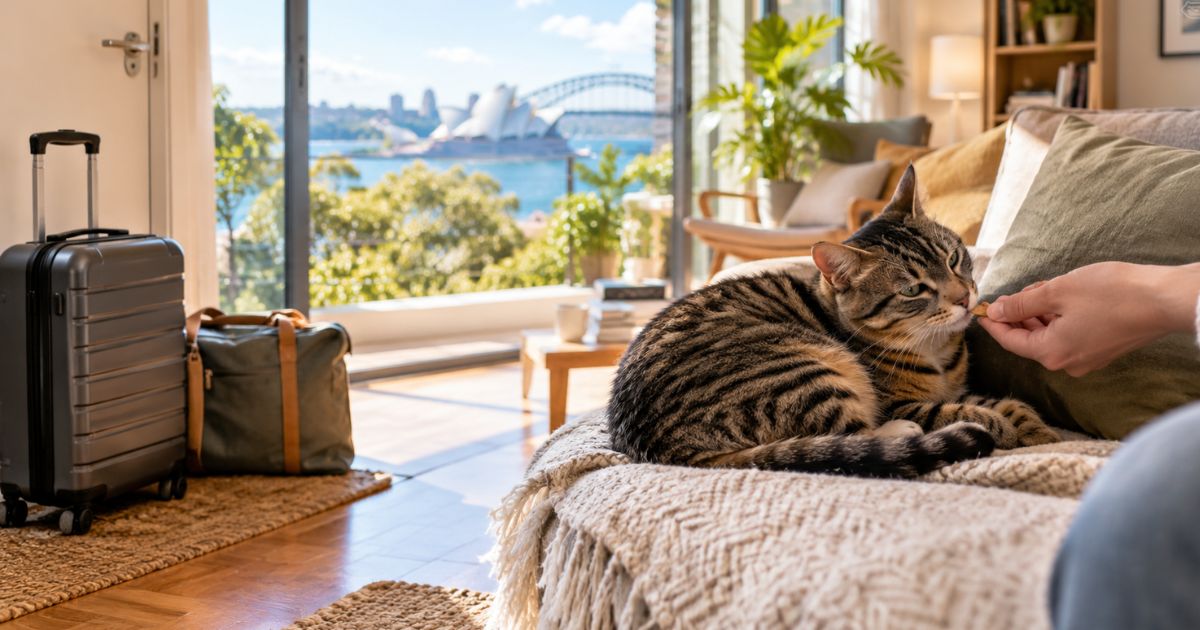
Going away? Compare cat sitters and catteries in Sydney, learn what NSW rules require, what to ask before you book, and which 24-hour emergency vets to know about.
Whether it's a summer holiday, Christmas with family or a work trip, sooner or later most Sydney cat owners need someone to look after their cat. The choice usually comes down to two options: a cat sitter who visits or stays in your home, or a boarding cattery.
Advertisement
Both can work well. The right choice depends on your cat's personality, health and age, how long you'll be away, and the time of year. This guide explains the pros and cons of each option, what New South Wales rules require of catteries, the questions to ask before you book, and how to prepare your cat so your trip is stress-free for both of you.
Cat sitter or cattery: which is better?
Cat sitting at home
A cat sitter either visits your home once or twice a day, or stays in your home while you're away.
Pros:
- Your cat stays in familiar surroundings, which many cats find much less stressful.
- No travel in a carrier, which some cats hate.
- Less contact with other cats, which lowers the risk of picking up infections.
- Your home is also checked: mail collected, plants watered and the house looking lived in.
- Good for multi-cat households, since all your cats stay together.
Cons:
- With visits only, your cat is alone for most of the day and night. Problems may not be noticed for hours.
- You're trusting someone with your home and keys.
- Quality varies a lot between sitters.
Best for: confident or anxious cats that dislike travel, cats that are healthy and independent, multi-cat homes, and shorter trips.
Boarding cattery
A cattery is a business that houses and cares for cats in purpose-built enclosures.
Pros:
- Staff check on cats every day, and NSW rules require catteries to have arrangements with a vet.
- Secure enclosures mean your cat can't escape or get lost.
- Good catteries are used to managing medications and special diets.
- Useful for longer trips, when daily visits would leave a cat alone for too long.
Cons:
- New surroundings, sounds and smells can stress some cats.
- Your cat must travel there and back.
- Cats are near other cats, so up-to-date vaccinations are essential.
- Popular catteries in Sydney book out early, especially over Christmas, New Year and school holidays.
Best for: cats with medical needs that need close monitoring, longer trips, cats that cope well with change, and kittens or young cats that might get into mischief at home alone.
A quick way to decide
| Situation | Usually better choice |
|---|---|
| Short trip (a few days), healthy adult cat | Cat sitter visits |
| Anxious cat that hates the carrier | Cat sitter at home |
| Several cats | Cat sitter at home |
| Cat needs regular medication or monitoring | Cattery or experienced live-in sitter |
| Long trip (two weeks or more) | Cattery or live-in sitter |
| Elderly cat with health problems | Ask your vet first |
What NSW rules say about catteries
In New South Wales, boarding establishments are covered by the NSW Animal Welfare Code of Practice No 5: Dogs and cats in animal boarding establishments, published by the NSW Department of Primary Industries. Knowing the key standards helps you choose a well-run cattery. Under the Code:
Vaccinations
- Cats must be vaccinated against feline infectious enteritis and feline respiratory disease ("cat flu").
- A vaccination certificate dated within the previous 12 months must be shown before admission.
- Cats known or suspected to have an infectious disease shouldn't be admitted.
- Cats under three months old shouldn't be admitted for boarding.
Tip: Check your cat's vaccination date well before you book. If a booster is due, give it enough time; ask your vet how long before boarding it should be done.
Housing
- Cats must not be kept in the same cage or run as dogs, even if they come from the same household.
- Cats should be housed away from dogs, as barking can disturb them.
- Cats should preferably be housed alone, except compatible cats from the same household.
Hygiene
- Cat housing should be cleaned daily, with surfaces disinfected weekly.
- Litter must be changed at least once a week, and each new arrival should get fresh litter.
- Some cleaning products, such as pine oil and phenol, are toxic to cats and must not be used where cats are kept.
Daily checks and vet care
- Each animal must be checked at least once a day.
- New arrivals should be monitored for their first three to four days to make sure they're eating.
- The cattery must have arrangements with a local vet.
- Owners must be asked to sign an agreement authorising necessary vet treatment.
- Signs such as vomiting, coughing, weight loss or being unable to pass urine or faeces require vet attention.
Records
The cattery must record your cat's details on admission, including vaccination status, your contact details, your expected pick-up date, any medical, dietary or grooming needs, and the name and phone number of your usual vet.
If a cattery can't clearly answer questions about these standards, that's a warning sign.
Questions to ask a Sydney cattery
Visit before you book. A good cattery will be happy to show you around. Ask:
- Can I see where my cat will stay? Look for clean, dry, well-ventilated enclosures with shelving to climb, a hiding spot and a view.
- Are cats kept away from dogs? The Code says they should be housed away from dogs.
- How do you keep cats cool in summer? Sydney heatwaves are a real risk. Ask about air conditioning, shade and ventilation. Read our guide to keeping cats cool in an Australian summer.
- What vaccinations do you require, and do you check certificates? A good cattery always asks.
- Which vet do you use, and what happens in an emergency?
- How often are cats checked, and by whom?
- Can I bring my cat's own food, bedding and toys?
- Can you give medications? Ask how they record doses.
- What are your opening hours for drop-off and pick-up? Some catteries close on public holidays.
- What are the total costs? Ask about extra charges for medications, special diets or peak periods.
Questions to ask a cat sitter
Whether you find a sitter through a booking platform, a friend or a local service, ask:
- What experience do you have with cats? Especially cats like yours: shy, elderly, or on medication.
- How long will each visit be, and how many visits a day?
- Will you send updates and photos?
- Can you give medication? If so, how?
- What will you do if my cat seems unwell or won't eat?
- Do you have insurance and a police check? Platforms vary in what checks they do, so ask.
- Can we do a meet-and-greet first? Watch how they interact with your cat.
- What happens if you get sick or can't make a visit? Ask about a backup plan.
- Will you keep my cat indoors? This is important for safety, especially in an unfamiliar routine.
Advertisement
How to prepare your cat before you go
Two to four weeks before
- Book early, especially for Christmas, New Year and school holidays.
- Check your cat's vaccinations are up to date if you're using a cattery.
- Make sure your cat's microchip details are current on the NSW Pet Registry, so your cat can be returned to you if it escapes.
- Book a vet check if your cat is elderly or has health problems.
- Restock food, litter and any medications, with extra in case you're delayed.
The week before
- Arrange a meet-and-greet with your sitter, or visit the cattery.
- Get your cat used to its carrier: leave it out with a blanket and treats inside.
- Write a clear care sheet.
What to include in a care sheet
- Feeding: what, how much and when
- Medications: name, dose, timing and how to give it
- Litter: where trays are and how often to clean them
- Hiding spots: where your cat likes to go when stressed
- Behaviour: what's normal for your cat and what isn't
- Your contact details and an emergency contact in Sydney
- Your usual vet's name, address and phone number
- The nearest 24-hour emergency vet
- Written permission for the sitter or cattery to get vet treatment, and how it will be paid for
On the day
- Keep your cat indoors the night before so it's easy to find.
- Pack familiar bedding or an item that smells like home.
- Stay calm. Cats often pick up on stress.
Sydney-specific risks to plan for
Summer heat
Sydney summers can bring heatwaves, especially in western Sydney. If your cat stays home, make sure the sitter knows to keep blinds closed, leave cool rooms open and provide plenty of water. Ask whether they can check on your cat more often during extreme heat.
Paralysis ticks
Paralysis ticks are found along Australia's east coast, including around Sydney, particularly in bushland areas. Ask your sitter or cattery to check your cat for ticks, and keep your cat's tick prevention up to date before you leave. Read our guide to paralysis ticks in cats.
Snakes
If you live near bushland, snakes are more active in warm months. Indoor cats are much safer. See our guide to snake bites in cats.
Christmas lilies
If someone sends flowers while you're away, ask your sitter to keep any lilies out of the house. Lilies can cause fatal kidney failure in cats. Read why lilies are deadly to cats.
24-hour emergency vets in Sydney
Give your sitter the details of your nearest 24-hour emergency vet, as well as your regular vet. These hospitals in the Sydney area are listed as offering emergency care. Opening hours can change, so call ahead to confirm before you travel.
| Hospital | Suburb |
|---|---|
| SASH (Small Animal Specialist Hospital) | North Ryde |
| Animal Referral Hospital, Homebush | Homebush West |
| Animal Referral Hospital, Baulkham Hills | Baulkham Hills |
| University of Sydney Small Animal Hospital | Camperdown |
Tell your sitter to call ahead on the way if possible, so the hospital can prepare.
NSW registration rules to know
If you're thinking about getting a cat, or your cat's details need updating before a trip, here are the key NSW rules, as explained by Inner West Council:
- Cats must be microchipped by 12 weeks of age, or when ownership is first transferred, whichever comes first.
- Cats must be registered on the NSW Pet Registry. Inner West Council advises that lifetime registration must now be done by 12 weeks of age or when ownership changes.
- Cats that aren't desexed by 4 months of age need an annual permit, introduced from 1 July 2020, on top of registration.
- Keep your contact details up to date on the NSW Pet Registry, because councils use them to contact you.
Fees are set by the NSW Government and change each year. Inner West Council lists, from 1 July 2026, a $74 cat registration fee and a $104 annual permit for non-desexed cats. Check with your council for current fees and any concessions.
Frequently asked questions
How far in advance should I book a cattery in Sydney?
As early as you can. Popular catteries can book out weeks or months ahead for Christmas, New Year, Easter and school holidays.
Is it better to leave my cat at home or in a cattery?
It depends on your cat. Many cats are calmer at home with a reliable sitter. Cats that need medication, close monitoring or that are left for long periods may be better in a good cattery. Ask your vet if you're unsure.
Do Sydney catteries require vaccinations?
Under the NSW Code of Practice for boarding establishments, catteries must see a vaccination certificate, dated within the previous 12 months, showing your cat is vaccinated against feline infectious enteritis and feline respiratory disease.
Can a kitten go to a cattery?
The NSW Code says cats under three months old shouldn't be admitted for boarding. Older kittens must be fully vaccinated.
How many visits a day does a cat need from a sitter?
Most healthy adult cats are fine with one or two visits a day. Kittens, elderly cats, cats on medication and cats in hot weather may need more. Discuss it with your sitter and vet.
What should I do if my cat stops eating while I'm away?
Ask your sitter or cattery to contact your vet if your cat hasn't eaten for a day, or sooner if your cat seems unwell. Cats that stop eating can become seriously ill. The NSW Code requires catteries to monitor new arrivals' eating for the first three to four days.
Related guides
Sources
- NSW Department of Primary Industries, NSW Animal Welfare Code of Practice No 5: Dogs and cats in animal boarding establishments
- Inner West Council, Registration and microchipping pets
- Perfect Pets, Emergency and after-hours vets near Sydney
This guide is general information only. Check details directly with your cattery, cat sitter, council and vet.
Advertisement