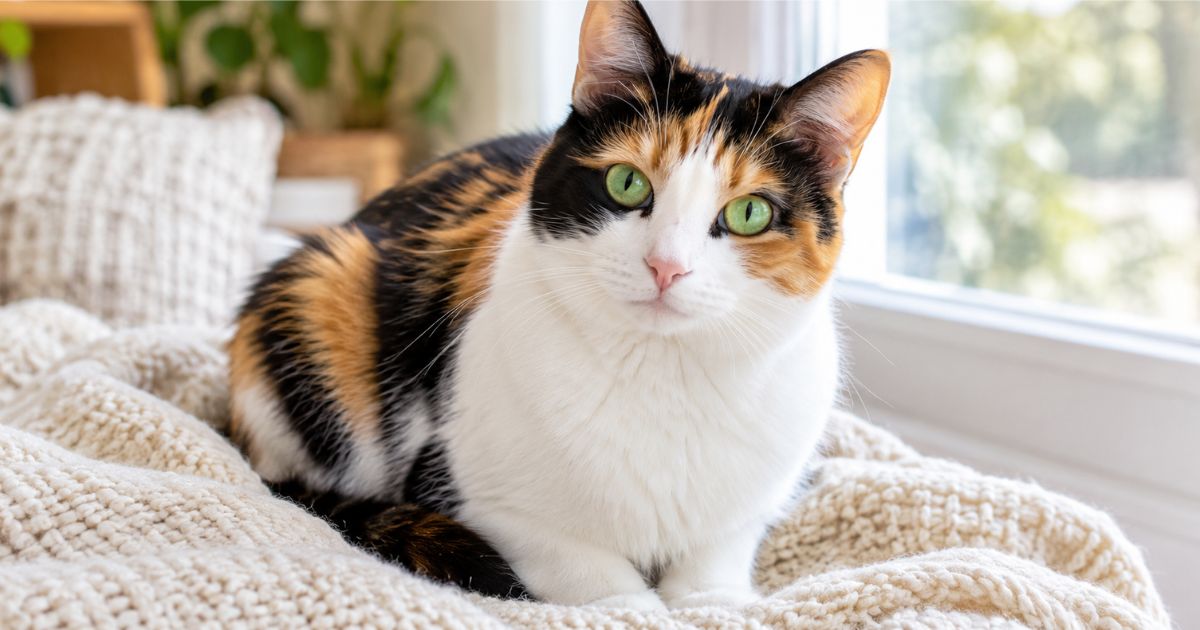
Why are calico cats almost always female? Is calico a breed? How is a calico different from a tortoiseshell or tuxedo cat? The science, myths and care tips in one place.
With their patchwork coats of white, black and orange, calico cats are some of the most eye-catching cats around. They're also surrounded by questions. Is calico a breed? Why are calico cats almost always female? Are they really more "sassy" than other cats?
Advertisement
The answers come from some fascinating genetics, including a discovery about orange fur that scientists only solved in 2025. Below you'll find what makes a cat calico, how rare male calicos are, how calicos differ from tortoiseshell and tuxedo cats, what the research says about calico personality, and how to care for one.
Quick answer: what is a calico cat?
A calico cat is a cat with a three-colour coat: white, plus patches of black and orange (or their softer "dilute" versions, grey and cream). Calico is a colour pattern, not a breed, so it can appear in many breeds as well as in everyday domestic cats. Because of the way orange fur is inherited on the X chromosome, almost all calico cats are female.
Is calico a breed?
No. Calico describes the colour pattern of a cat's coat, not its breed. You'll find calico domestic shorthairs and domestic longhairs in shelters everywhere, and many pedigree breeds also come in calico, often listed by breeders as "tortie and white" or "tricolour".
This is the same reason you won't find a "tabby breed" or a "tuxedo breed". These names describe what a cat looks like, while a breed describes its ancestry.
Calico colour variations
| Variation | What it looks like |
|---|---|
| Classic calico | Bold patches of black and orange on a white coat |
| Dilute calico | Softer patches of grey (blue) and cream on white |
| Calico tabby (caliby) | Calico patches with tabby stripes in the coloured areas |
| Low-white calico | Mostly black and orange patches, with only a little white |
| High-white calico | Mostly white, with small patches of colour |
Why are calico cats almost always female?
This is the most famous calico fact, and it comes down to the X chromosome.
The orange gene lives on the X chromosome
Cats, like people, have sex chromosomes. Females usually have two X chromosomes (XX), and males usually have one X and one Y (XY).
The gene that turns fur orange sits on the X chromosome. A cat's X chromosome carries either the instruction for orange fur or for non-orange (black-based) fur.
- A male cat has only one X chromosome, so he's usually either orange or black-based, not both.
- A female cat has two X chromosomes, so she can carry one orange version and one black version.
How the patches form
Early in development, each cell in a female's body randomly switches off one of its two X chromosomes. If the active X carries orange, that patch of skin grows orange fur. If the other X is active, the fur is black. The result is a patchwork of orange and black.
Calico cats also carry a separate white-spotting gene, which adds the white areas. A female with the orange-and-black patchwork but little or no white is a tortoiseshell.
The 2025 breakthrough
For more than 60 years, scientists knew orange fur was linked to the X chromosome but couldn't find the exact gene. In 2025, two research teams working independently, one at Stanford University in the United States and one at Kyushu University in Japan, published results in the journal Current Biology.
According to ScienceAlert's report on the research, both teams found that orange cats carry a small deletion of DNA near a gene called Arhgap36 on the X chromosome. In orange fur, skin cells produced about 13 times more RNA from this gene than in non-orange fur. This finally explains, at the genetic level, why orange and calico colouring is inherited the way it is.
How rare are male calico cats?
Very rare. Veterinarian Dr Marty Becker, writing for Vetstreet, says only about 1 in every 3,000 calico cats is male, citing research from the University of Missouri College of Veterinary Medicine.
Most male calicos have an extra X chromosome, giving them an XXY combination. With two X chromosomes, they can show both orange and black patches, just like a female. Dr Becker explains that these cats are known as Klinefelter males, after the similar condition in people, and that they're usually sterile.
So if someone offers you a "rare male calico" as a breeding cat or an investment, be sceptical. A male calico is a genetic quirk, not a moneymaker, and he deserves a home as a pet like any other cat.
Calico vs tortoiseshell vs tuxedo cats
These three patterns are often confused. Here's how to tell them apart.
| Pattern | Colours | Is it mostly female? | Key feature |
|---|---|---|---|
| Calico | White plus patches of black and orange | Yes, almost always | Clear patches of colour on white |
| Tortoiseshell (tortie) | Black and orange mixed or brindled together | Yes, almost always | Little or no white |
| Tuxedo | Black and white | No, males and females | Looks like it's wearing a formal suit |
Tortoiseshell cats
A tortoiseshell has the same orange-and-black genetics as a calico, but without much white. The colours are often mixed together in a mottled or brindled pattern rather than in clear patches. Dilute torties have grey and cream instead.
Tuxedo cats
A tuxedo cat is a black-and-white bicolour cat, usually with a black back and a white chest, paws and sometimes face, like a dinner suit. Because it doesn't involve the orange gene, tuxedo cats can be male or female.
How to tell if your cat is a calico
Not sure what to call your cat's colouring? Work through these questions:
- Does your cat have three colours? Look for white, plus black (or grey) and orange (or cream). If there's no orange or cream at all, your cat isn't a calico or tortie.
- How much white is there? Clear white areas, often on the chest, belly, legs and face, point to a calico. Little or no white points to a tortoiseshell.
- Are the colours in patches or mixed? Calicos usually have distinct blocks of colour. Torties often have colours finely mixed together.
- Are the colours soft or bold? Grey and cream instead of black and orange means a dilute calico or dilute tortie.
- Are there stripes inside the coloured patches? If so, your cat is a calico tabby, sometimes called a "caliby".
- Is your cat male? A male with true calico colouring is rare. Your vet can confirm the cat's sex during a check-up.
If your cat is black and white only, it's a bicolour, and if the black covers the back with white on the chest and paws, most people call it a tuxedo.
Do calico cats have a special personality?
Many owners swear their calicos have "tortitude" or "calitude": a confident, sassy, independent streak. Is there any science behind it?
What the research says
A survey-based study led by Dr Elizabeth Stelow, a veterinary behaviourist at the University of California, Davis, looked at coat colour and aggression in cats. The American Animal Hospital Association reports that owners of tortoiseshell, calico and black-and-white cats reported more frequent aggressive behaviours during daily handling.
But there are important limits. That study was based on what owners reported, not on direct observation. The AAHA article also points out that surveys in this area don't use the same coat colours or ask the same questions, so results are hard to compare. It quotes researchers noting that socialisation and environment also influence personality, and states that, so far, no one has found that genes controlling coat colour have any influence on behaviour.
Advertisement
The bottom line on calico personality
Every calico is an individual. A cat's personality is shaped by its genes, early socialisation as a kitten, its experiences and its environment. Choose a cat based on its own temperament, not its coat colour. Shelter staff can usually tell you a lot about each cat's personality.
The calico that became a state symbol
Calico cats are loved enough to have official status. According to the Maryland Manual, the calico became the official state cat of Maryland in the United States on 1 October 2001. Its orange, black and white colours match the state's bird, the Baltimore oriole, and its state insect, the Baltimore checkerspot butterfly.
Caring for a calico cat
A calico's care depends on its breed, coat length, age and health, not its colours. But there are a few things worth knowing.
Protect the white areas from the sun
The white patches on a calico, especially on the ears and nose, have no pigment to protect them from UV light. RSPCA South Australia warns that cats with white or thin fur can suffer severe sunburn and are prone to skin cancer, especially on the ears, nose and eyelids. Squamous cell carcinoma is the most common skin cancer in white cats.
In sunny Australia, the best protection is keeping your cat indoors or in a shaded enclosure during the middle of the day. Ask your vet about cat-safe sun protection if your cat goes outside, and get any scabs or sores on the ears or nose checked promptly. An outdoor enclosure lets your cat enjoy fresh air safely. See our guide to cat enclosures and catios.
Keep up regular health care
Calico colouring itself isn't linked to any specific disease. Like all cats, calicos need vaccinations, parasite control, desexing, dental care and regular vet check-ups. Watch for changes in appetite, behaviour or litter habits, and read our guide on how to tell if your cat is sick.
Groom according to coat length
Short-haired calicos usually need a weekly brush. Long-haired calicos need more frequent grooming to prevent mats.
How to find a calico cat
Calico kittens and adult cats are common in shelters and rescue groups. RSPCA Australia encourages people looking for a pet to first consider adopting from the RSPCA or another reputable animal welfare organisation.
Steps to adopting a calico
- Search shelter and rescue listings in your area and filter by colour if the site allows it. Look for "calico", "tortie and white" or "tricolour".
- Visit and meet the cat. Ask staff about its personality, history and how it gets on with people and other animals.
- Think about your home. Check if your council or state requires cats to be contained. Our guide to cat laws in Australia explains the rules.
- Budget for care, including food, vet visits and insurance. Read our guide to cat vet costs in Australia.
- Prepare your home with a litter tray, scratching posts, a bed, hiding spots and toys before your cat arrives.
- Give your new cat time to settle in, starting with one quiet room.
Your calico cat checklist
- [ ] I know calico is a colour pattern, not a breed.
- [ ] I've checked shelters and rescue groups before buying.
- [ ] I've met the cat and asked about its personality.
- [ ] I've checked my local cat containment rules.
- [ ] I have a plan to protect my cat's white ears and nose from the sun.
- [ ] I've budgeted for vaccinations, desexing, vet care and insurance.
- [ ] My home is ready with a litter tray, scratching post, bed and toys.
- [ ] I'll book a vet check-up soon after adoption.
Frequently asked questions
Are all calico cats female?
Almost all. The orange colour gene sits on the X chromosome, and a cat usually needs two X chromosomes to show both orange and black. Females have two X chromosomes. Male calicos exist but are rare, and most have an extra X chromosome (XXY).
How rare is a male calico cat?
Dr Marty Becker, writing for Vetstreet, says only about 1 in 3,000 calico cats is male, citing University of Missouri research. Most male calicos are XXY and usually sterile, so they can't be used for breeding.
What's the difference between a calico and a tortoiseshell cat?
Both have orange and black colouring, but a calico also has clear white areas, usually with distinct patches of colour. A tortoiseshell has little or no white, and its colours are often mixed together.
Is there a Neapolitan cat breed?
No. There's no recognised cat breed called the Neapolitan cat. A calico's three colours are sometimes compared to Neapolitan ice cream, which has three flavours side by side. If you're looking for a tricolour cat, a calico is what you want.
Is there an emperor cat or Antarctica cat breed?
No, neither is a recognised cat breed. Emperor penguins live in Antarctica, and their black-and-white colouring is similar to a tuxedo cat's. A tuxedo cat is a black-and-white bicolour cat, not a breed.
Are calico cats more aggressive?
Not necessarily. In a UC Davis survey, owners of calico, tortoiseshell and black-and-white cats reported more aggressive behaviour during handling. But the study relied on owners' reports, and the AAHA notes that no one has found that genes controlling coat colour influence behaviour. Socialisation and environment matter more.
Do calico cats live longer?
There's no evidence that coat colour affects lifespan. A calico's life expectancy depends on its breed, genetics, health care, diet and whether it lives safely indoors or in a contained area.
Related guides
- How to tell if your cat is sick
- Is cat insurance worth it in Australia?
- Cat enclosures and catio ideas
Sources
- ScienceAlert, The secret of orange cats finally uncovered after 60-year search
- Vetstreet, Dr Marty Becker, Can calico cats be male?
- American Animal Hospital Association, What does a cat's color tell us?
- Maryland Manual On-Line, Maryland state cat: calico cat
- RSPCA South Australia, Keeping your white pet safe from sunburn
- RSPCA Australia Knowledgebase, How do I find a responsible dog or cat breeder?
This guide is general information only and is not a substitute for advice from your vet.
Advertisement