Pine needles, tree water, plastic branches and toppling trees: we compare real and artificial Christmas trees for homes with cats, and explain how to make either one safer.
This article contains affiliate links. As an Amazon Associate, we earn from qualifying purchases, at no extra cost to you. Learn more.
Advertisement
Every year, cat owners face the same festive question: should you bring home a real Christmas tree, with its fresh pine scent, or stick with an artificial one? If you share your home with a curious cat, the choice matters more than you might think.
Both types of tree come with risks. Real trees drop needles and sit in water that cats love to drink. Artificial trees can be chewed, and both can be climbed and knocked over. The good news is that either tree can be made much safer with a few simple precautions.
Below we compare real and artificial Christmas trees side by side, explain what vets say about the risks, and help you choose the best option for your home and your cat.
Quick answer
Neither tree is completely cat-proof, but an artificial tree usually carries fewer health risks. Real trees add hazards from needles, tree oils and tree water, which PetMD notes can contain harmful additives. Artificial trees avoid those risks, but plastic pieces can still cause mouth irritation or blockages if chewed. With either tree, the biggest dangers are often toppling and decorations, especially tinsel. Secure your tree, decorate carefully, and give your cat its own climbing space.
Real vs artificial: side-by-side comparison
| Factor | Real tree | Artificial tree |
|---|---|---|
| Needles | Mildly toxic if eaten, can cause irritation or blockages | No real needles, but plastic tips can be chewed off |
| Tree water | Cats may drink it, additives can be toxic | No water |
| Tree oils and sap | Can irritate the mouth and stomach | None |
| Chewing | Branches and needles | Plastic or metal pieces can cause irritation or blockages |
| Toppling | Heavy, can fall if climbed | Often lighter, can tip more easily |
| Scent attraction | Fresh, outdoorsy smell attracts curious cats | Less interesting smell |
| Mess | Daily needle drop | Little mess |
| Best for | Calm adult cats, supervised homes | Kittens, chewers, busy households |
The risks of a real Christmas tree
Needles
PetMD explains that needles from fir, spruce and pine trees are mildly toxic if eaten, mainly because of their sap and oil. A cat would usually need to eat a lot to be severely poisoned, but even small amounts can cause stomach upset and mouth irritation.
The bigger concern is physical. PetMD warns that fallen needles can cause blockages or punctures in the oesophagus, stomach or intestines. Kittens and cats that like to chew plants are most at risk.
Cats Protection advises stopping your cat from nibbling or licking a real tree and picking up fallen needles regularly.
Tree water
Cats are often fascinated by the water in a tree stand. PetMD warns that tree water can contain tree oils, and that common additives such as fertilisers, preservatives and sugar substitutes, especially xylitol, can be toxic and very harmful to cats. Effects can range from an upset stomach to seizures, liver problems and kidney problems.
PetMD recommends using a covered tree base, or blocking access entirely if you use any additives. Cats Protection also notes that real trees can carry toxic oils and fertiliser.
The outdoor smell
A fresh tree brings the smells of the outdoors inside. Many cats find this irresistible, which can mean more sniffing, chewing and climbing, especially in the first few days.
The risks of an artificial Christmas tree
Chewing plastic
Artificial trees avoid the needle and water risks, but they aren't risk-free. PetMD notes that chewing plastic or aluminium trees can cause mouth irritation, and swallowed pieces can cause intestinal blockages.
Cheaper artificial trees may shed small plastic tips more easily. Check your tree for loose pieces before decorating, and vacuum around it regularly.
Toppling
Artificial trees are often lighter than real trees, especially smaller ones. A climbing cat can tip a light tree more easily. Choose a tree with a sturdy, weighted base, and secure it to the wall.
Flocked and pre-lit trees
Flocked trees have a fake snow coating that cats may lick or chew. Pre-lit trees have wiring built into the branches, which can be a chewing risk. If your cat is a chewer, choose a plain, unflocked tree and add lights only on the upper branches.
Risks that apply to every tree
Whichever tree you choose, these hazards apply:
Toppling
Cats Protection recommends securing your tree with a sturdy base or weights. RSPCA Tasmania also advises securing the tree to the floor, wall or ceiling. A tree falling on a cat, or a cat falling with the tree, can cause injuries and frighten your cat badly.
Tinsel and string
RSPCA Tasmania warns that tinsel, ribbons and string-like items can wrap around the intestines and cause serious, potentially fatal damage. VCA Animal Hospitals lists vomiting, refusal to eat, dehydration and lethargy as the most common signs, and says surgery is usually needed. Skip tinsel completely in a home with cats.
Glass ornaments
Cats Protection advises avoiding glass baubles, which can shatter and cut paws and mouths. Choose shatterproof ornaments made from plastic, wood, paper or fabric.
Lights and cords
Cats Protection recommends covering light wires with plastic or cardboard tubes and switching lights off at the mains when you're out.
Which tree should you choose?
| Your cat | Better choice |
|---|---|
| A kitten | Artificial, small and well secured, or a pet playpen around the tree |
| A plant chewer | Artificial, plain and unflocked |
| A climber | Either, but heavy and secured to the wall |
| A calm adult cat | Either, with standard precautions |
| A cat that drinks from strange places | Artificial, or a real tree with a fully covered stand |
| A senior cat | Either, but watch for chewing and keep cords covered |
Making a real tree safer
- Choose a tree with good needle retention. Ask your tree seller which varieties hold their needles longest.
- Use a covered tree stand, and don't add fertilisers, preservatives or sugar to the water.
- Water from above so you don't leave the stand uncovered.
- Vacuum fallen needles daily.
- Secure the tree to the wall or ceiling.
- Keep decorations on the top half.
Making an artificial tree safer
- Choose a sturdy tree with a weighted base.
- Skip flocked or glitter-coated trees if your cat is a chewer.
- Check for loose plastic tips before decorating, and vacuum regularly.
- Secure the tree to the wall or ceiling.
- Keep pre-lit wiring out of reach, or choose an unlit tree and add lights only up high.
Practical things to weigh up
Safety isn't the only factor. Here are some practical points cat owners often consider:
Advertisement
| Consideration | Real tree | Artificial tree |
|---|---|---|
| Cost over time | Bought new every year | One purchase, reused for years |
| Storage | None needed after Christmas | Needs storage space all year |
| Mess | Daily needle drop and water top-ups | Minimal, though some trees shed plastic tips |
| Setup time | Quick, but needs watering daily | Quick, but branches need fluffing |
| Smell | Fresh pine scent | No scent |
| Stability | Heavy, stable when secured | Often lighter, needs a weighted base |
For many busy households with young cats, an artificial tree is simply easier to manage. For calm adult cats, a well-secured real tree with a covered stand can work well.
Helping your cat cope with the festive season
A new tree is only one of many changes at Christmas. Visitors, noise, new smells and a busy routine can all unsettle cats. Cats Protection notes that a strange atmosphere, with lots of unfamiliar people coming and going, can be unsettling for cats.
To help your cat stay calm, Cats Protection recommends:
- A quiet room where your cat can be left undisturbed
- A hiding place so your cat can escape the chaos
- An extra litter tray away from busy areas
- A pheromone diffuser, which some owners find helps their cat relax
A calm, relaxed cat is much less likely to go exploring in the Christmas tree.
The third option: a tree your cat can climb
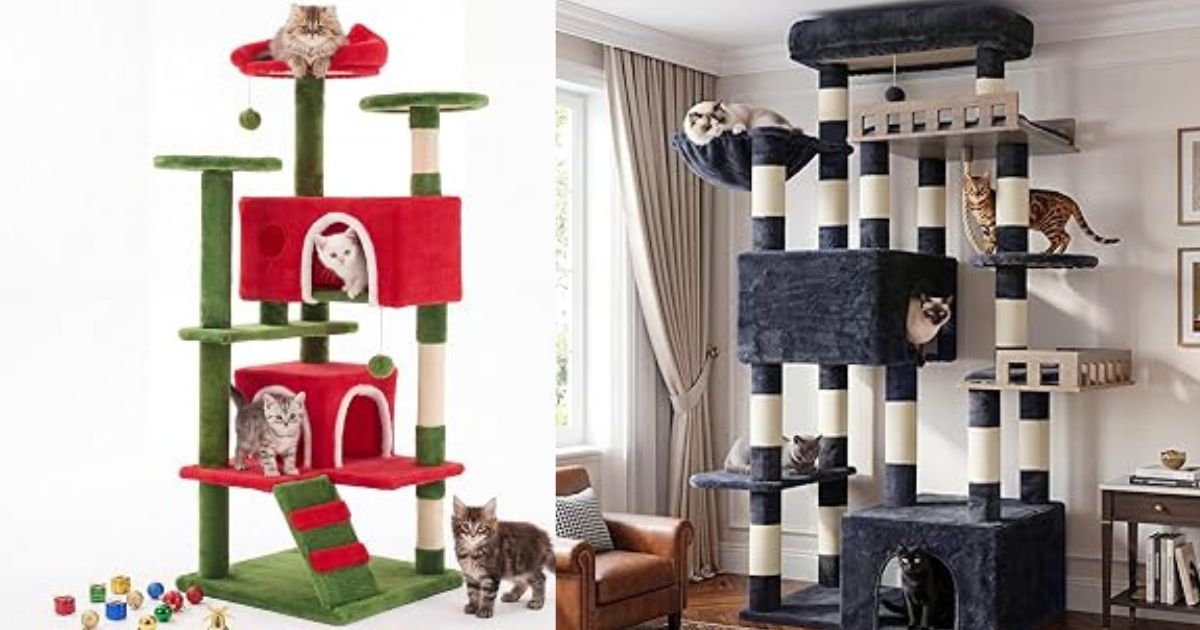
Many cat owners solve the problem by giving their cat its own Christmas tree: a cat tower designed in a festive tree shape. It gives your cat somewhere it's allowed to climb, scratch and nap, which can make the family tree far less tempting.
Some festive cat towers to consider:
- Compact: PuzzlePaw Christmas tree cat tower, about 88 cm, good for smaller homes, kittens and senior cats.
- Classic tree shape: LUCKLIFE 54" cat Christmas tree with 3 cozy condos, tall and green with three hideaways.
- Larger cats: Christmas cat tree with 2 condos and natural sisal scratching posts, with sturdier platforms.
Check the current price and reviews on each listing. Anchor tall cat towers to the wall, as VCA Animal Hospitals recommends, and remove any small decorations that come attached. Our full comparison is in our guide to Christmas tree cat trees.
What to do if something goes wrong
If your cat eats needles or drinks tree water
Watch for vomiting, drooling, pawing at the mouth, not eating or lethargy. PetMD advises calling your vet or a pet poison helpline if your cat eats any needles. In Australia, the Animal Poisons Helpline is available on 1300 869 738.
If your cat swallows tinsel or ribbon
Don't pull on anything hanging from your cat's mouth or bottom. Vet Help Direct warns that pulling can damage the intestines. Contact your vet straight away.
If the tree falls
Check your cat for injuries, limping or cuts from broken ornaments, and keep it in a quiet room while you clean up. See your vet if your cat seems hurt or unusually quiet.
Christmas tree safety checklist for cat owners
- [ ] I've chosen a tree that suits my cat's age and habits.
- [ ] The tree has a sturdy base and is secured to the wall or ceiling.
- [ ] For a real tree, the stand is covered and has no additives.
- [ ] Fallen needles or plastic tips are vacuumed daily.
- [ ] No tinsel, ribbon or string on the tree.
- [ ] Only shatterproof ornaments, on the top half.
- [ ] Light cords are covered and switched off when I'm out.
- [ ] My cat has its own climbing space away from the tree.
Frequently asked questions
Is a real Christmas tree safe for cats?
It can be, with precautions. PetMD says real tree needles are mildly toxic and can cause stomach upset or blockages, and tree water can contain harmful additives. Use a covered stand, pick up needles daily and secure the tree.
Are artificial Christmas trees safe for cats?
They avoid the needle and tree water risks, but PetMD notes that chewing plastic can cause mouth irritation, and swallowed pieces can cause blockages. Choose a sturdy, unflocked tree and secure it to the wall.
Which Christmas tree is best for a kitten?
A small artificial tree that's well secured is usually the safest choice, or place a pet playpen around any tree. Kittens are curious, chew more and can easily climb or knock over a tree.
Is Christmas tree water toxic to cats?
It can be. PetMD warns that additives such as fertilisers, preservatives and xylitol can be very harmful to cats. Use a covered stand and plain water.
Do cats prefer real or artificial trees?
Many cats find real trees more interesting because of their outdoor smell and texture. That can mean more sniffing, chewing and climbing, especially when the tree first arrives.
How do I stop my cat chewing the Christmas tree?
Give your cat safe alternatives, such as cat grass and its own cat tower, keep the lower branches bare, and supervise while your cat gets used to the tree. Our guide on how to keep cats out of the Christmas tree has 12 more tips.
Related guides
- How to keep cats out of the Christmas tree
- Christmas tree cat trees: 4 festive cat towers
- Lilies and cats: why they're so dangerous
Sources
- PetMD, Are Christmas trees toxic to cats?
- Cats Protection, Cats at Christmas
- RSPCA Tasmania, Make sure your pet has a pawsome Christmas
- VCA Animal Hospitals, Foreign body in cats
- Vet Help Direct, My cat's swallowed some string, should I pull it out?
This guide is general information only and is not a substitute for advice from your vet.
Advertisement