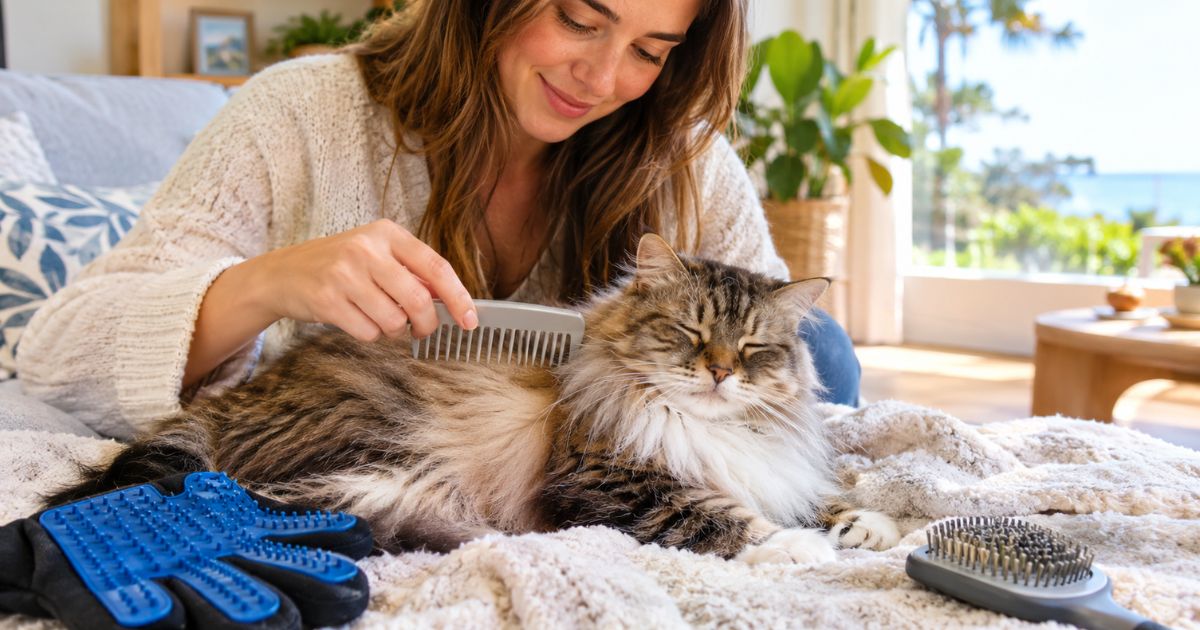
What cat grooming costs in Australia, which brushes, gloves and combs actually work, how to groom at home without a fight, and when a professional groomer or vet is the better choice.
Cats are famous for keeping themselves clean, so many owners are surprised to learn that their cat needs help. A long-haired cat can develop painful mats in days, an older cat may stop reaching its back and hips, and every cat sheds more in spring.
Advertisement
Cat grooming doesn't have to mean an expensive salon visit. Most cats can be kept in good condition at home with the right brush or comb and a few minutes a day. For heavily matted coats, lion cuts and nervous cats, a professional groomer or your vet clinic is often the safer choice.
Below you'll find what cat grooming costs in Australia, which grooming tools are worth buying, a step-by-step routine for grooming at home, and what it means when your cat grooms itself, or another cat, a lot.
Quick answer: how much does cat grooming cost in Australia?
According to Airtasker's Australian price guide, last updated in September 2026, the median price of a cat grooming job is about $135, with most jobs costing between $70 and $220.
| Service | Typical price (Airtasker) |
|---|---|
| Brushing or basic groom | $60 to $90 |
| Bath and brush | $80 to $120 |
| Full groom and trim | $110 to $170 |
| Lion cut | $140 to $220+ |
| Full-body clipping | $130 to $220+ |
| Nail trim (add-on) | $20 to $35 |
| De-matting a matted coat (add-on) | $20 to $60 |
| De-matting a severely matted coat (add-on) | $50 to $120+ |
These are indicative prices, and every groomer sets their own rates. Always ask for a quote that includes any de-matting or handling surcharges.
How often does a cat need grooming?
RSPCA Australia recommends grooming:
- Long-haired and medium-haired cats daily
- Short-haired cats about once a week
Grooming needs rise for all cats during shedding season. Cats Protection, the UK cat charity, notes that even short-haired cats may need brushing twice a week in spring and autumn, when they shed the most.
RSPCA Australia adds that older cats and cats with arthritis or other mobility problems may need more frequent grooming, because they find it harder to groom themselves. Overgrown claws are also more common in older cats, so check their nails regularly.
Cats that need extra help
- Long-haired breeds such as Persians, Maine Coons, Ragdolls and Siberians
- Senior cats and cats with arthritis
- Overweight cats that can't reach their back end
- Cats wearing a cone after surgery
- Cats with something stuck in their fur
Cats Protection advises removing anything stuck in your cat's fur yourself, rather than leaving your cat to lick it out and swallow it.
The best cat grooming tools (and which ones you need)
RSPCA Australia's advice is simple: grooming equipment should match your cat's coat type. You don't need a drawer full of gadgets.
For short-haired cats
RSPCA Australia says a fine-toothed flea comb, a soft brush and a grooming mitt or glove should be enough for short-haired cats.
- Soft brush: removes loose hair and spreads natural oils through the coat.
- Grooming glove: a rubber-nubbed glove that feels like being stroked. Cats Protection says mitts suit short-haired cats that prefer something that feels like you're just patting them. They're a good choice for cats that dislike brushes.
- Flea comb: a fine-toothed comb that catches fleas, flea dirt and loose hair.
For long-haired and medium-haired cats
RSPCA Australia says long and medium coats may also need a wide-toothed comb and longer brushes.
- Wide-toothed comb: the most important tool for a long-haired cat. It works through the coat down to the skin and finds tangles before they become mats.
- Slicker brush: fine wire bristles that lift loose undercoat. Use a light touch, because pressing hard can scratch the skin.
- Blunt-nosed safety scissors: RSPCA Australia says these can be used carefully to break up a mat, without touching the skin.
Grooming clippers
Clippers are mainly for professionals. Mats sit very close to the skin, and it's easy to nick a wriggling cat. RSPCA Australia advises seeking help for mats that are tight, large or close to the skin, and notes that vet clinics usually offer grooming services.
If you do buy clippers for light tidying, choose quiet clippers designed for pets, and never use scissors or clippers on a mat you can't see the skin under.
Grooming vacuums
Grooming vacuums attach a brush to a vacuum hose so loose hair is sucked away. Some relaxed cats tolerate them, but many cats are frightened by vacuum noise. Introduce one very slowly, and stop if your cat seems stressed.
Grooming hammocks and restraint bags
These hold a cat still for nail trims. Cats Protection recommends grooming with as little restraint as possible, building up a little at a time. If your cat needs to be held tightly to be groomed, it's usually kinder to ask your vet nurse or a professional groomer for help.
Grooming wipes
Pet-safe wipes can clean small spots, but most cats don't need them. Cats Protection says a soft cloth dampened with warm water is usually enough for spot cleaning.
Which tools does your cat need?
| Coat type | Essential tools | Optional extras |
|---|---|---|
| Short hair | Soft brush or grooming glove, flea comb | Nail clippers |
| Medium hair | Wide-toothed comb, soft brush, flea comb | Slicker brush |
| Long hair | Wide-toothed comb, slicker brush, flea comb | Safety scissors, de-shedding tool |
| Hairless (e.g. Sphynx) | Soft cloth | Vet-recommended skin-care products |
| Senior or arthritic cat | Soft brush or grooming glove | Nail clippers |
How to groom your cat at home
Most cats can learn to enjoy grooming if you go slowly. Cats Protection suggests introducing combs and brushes early, using as little restraint as possible, and building up a little at a time.
Step-by-step grooming routine
- Choose a calm time. A relaxed, sleepy cat after a meal is ideal. Avoid times when your cat wants to play or go out.
- Start with patting. Stroke your cat for a minute before you pick up the brush.
- Begin where your cat likes being touched, usually the cheeks, head and back.
- Brush in the direction of the fur with gentle strokes. For long coats, comb in small sections, working from the skin outwards.
- Check for tangles and mats behind the ears, under the legs, on the belly and around the back end. These are the areas that mat first.
- Tease out small tangles with your fingers. RSPCA Australia warns not to pull the fur, because this tightens the skin and causes pain.
- Check the skin and coat. Look for fleas, flea dirt, scabs, lumps and bald patches.
- Keep sessions short. A few minutes is enough at first. Stop before your cat gets annoyed.
- Reward your cat with a treat or play, so grooming becomes a good experience.
Don't forget a tick check
In eastern Australia, especially along the coast from north Queensland to eastern Victoria, grooming is a good time to check your cat for paralysis ticks. Run your fingertips slowly over the whole body, paying attention to the head, neck, ears and between the toes. Learn what to look for in our guide to paralysis ticks in cats.
Should you bath your cat?
Usually not. RSPCA Australia says most cats don't tolerate bathing well and often find it very stressful. Vets may occasionally recommend a bath as part of treatment for a skin condition. Cats Protection advises calling your vet first if your cat has anything potentially toxic in its fur.
Professional cat grooming: when it's worth paying for
Home grooming covers most cats, but a professional groomer or vet clinic is the better choice when:
- Your cat has large or tight mats, especially close to the skin
- Your long-haired cat needs a lion cut or full clip
- Your cat is too stressed or aggressive to groom at home
- Your senior cat has become matted because it can no longer groom itself
- You need nail trims and aren't confident doing them
Groomer, mobile groomer or vet clinic?
Advertisement
| Option | Best for | Things to know |
|---|---|---|
| Grooming salon | Regular grooms, lion cuts, bath and brush | Your cat has to travel, which stresses some cats |
| Mobile or at-home groomer | Nervous cats, seniors, multi-cat homes | Usually costs more because the groomer travels to you |
| Vet clinic | Severe matting, anxious or aggressive cats, cats with health problems | Can offer sedation if needed; RSPCA Australia notes most clinics offer grooming |
What cat grooming costs in Australian cities
Airtasker's guide gives these indicative price ranges for cat grooming in major Australian cities:
| City | Typical price range |
|---|---|
| Sydney | $120 to $170 |
| Canberra | $115 to $165 |
| Melbourne | $110 to $160 |
| Perth | $110 to $160 |
| Brisbane | $105 to $155 |
| Gold Coast | $105 to $155 |
| Adelaide | $100 to $150 |
| Hobart | $95 to $145 |
Airtasker lists the main factors that push up the price: the type of groom, the coat's length and condition, your cat's size (large breeds such as Maine Coons cost more) and your cat's temperament.
How to choose a cat groomer near you
- Ask your vet clinic whether it offers grooming or can recommend a cat-friendly groomer.
- Look for cat experience. Grooming cats is very different from grooming dogs. Ask how many cats they groom each week.
- Ask about quiet times. Some groomers book cats when there are no dogs in the salon.
- Ask what happens if your cat is too stressed. A good groomer will stop and suggest a vet visit rather than force it.
- Get a full quote that covers de-matting, nail trims and any handling fees.
- Read local reviews from other cat owners, not just dog owners.
Do lion cuts keep cats cool in summer?
Many Australian owners book a lion cut before summer. For a long-haired cat with a matted coat, a clip can make life much more comfortable. For a cat with a healthy, well-brushed coat, regular brushing to remove loose undercoat is often enough. Clipped cats can also get sunburnt, so keep them indoors in strong sun. See our guide to keeping cats cool in an Australian summer for more tips.
Why is my cat grooming itself so much?
Cats spend a lot of their day grooming. Cats Protection notes that cats spend a significant amount of time grooming themselves to keep their coat and skin clean. A cat grooming itself in front of you, or even on top of you, is usually a sign it feels safe and relaxed.
But grooming too much is a different story. Signs of overgrooming include:
- Bald or thin patches, often on the belly, inner thighs or front legs
- Chewing or pulling fur
- Sore or broken skin
- Hairballs more often than usual
Common causes of overgrooming
A veterinary dermatology handbook from the University of Minnesota lists several causes of self-inflicted hair loss in cats:
- Parasites, including heavy flea infestations and mites
- Allergies, including food allergies and skin allergies
- Discomfort from other illnesses, such as hyperthyroidism
- Stress or anxiety, triggered by things like a new pet, a new baby, visitors, moving house or boarding
The handbook says stress-related overgrooming should only be diagnosed after parasites, allergies and other illnesses have been ruled out. That's why a vet visit is the first step. Cats Protection also says any change in your cat's grooming habits can be a sign of a problem, and suggests filming the behaviour to show your vet.
A cat that stops grooming also needs attention. A scruffy, greasy or matted coat can be a sign of pain, arthritis, dental disease or illness. Read our guide on how to tell if your cat is sick.
Why do cats groom each other?
Grooming between cats is called allogrooming. It's commonly seen in cats that live together and get along.
A study of a group of cats by Dr Ruud van den Bos, published in the Journal of Ethology in 1998, found that:
- Grooming was mostly directed at the head and neck, the areas a cat can't reach easily itself.
- Higher-ranking cats groomed lower-ranking cats more often than the other way around.
- Grooming was sometimes followed by mild aggression, and the author suggested allogrooming may help redirect tension between cats.
So when one cat grooms another and then suddenly swats it, that's normal behaviour and not necessarily a fight. Watch for real signs of conflict, such as hissing, chasing, blocking access to food or litter trays, or one cat hiding.
Your cat grooming checklist
- [ ] I have the right tools for my cat's coat type.
- [ ] I groom my long-haired cat daily, or my short-haired cat weekly.
- [ ] I check behind the ears, under the legs and the belly for mats.
- [ ] I check my cat for ticks and fleas during grooming.
- [ ] I check my older cat's claws regularly.
- [ ] I keep sessions short and reward my cat afterwards.
- [ ] I never pull at mats or cut close to the skin.
- [ ] I know which local groomer or vet clinic to call for severe mats.
- [ ] I'll see my vet if my cat overgrooms, develops bald patches or stops grooming.
Frequently asked questions
What is the average cost of cat grooming in Australia?
Airtasker's Australian price guide puts the median cat grooming job at about $135, with most jobs between $70 and $220. A basic brush costs less, while lion cuts and de-matting severely matted coats cost more. Get a written quote first.
What is the best cat grooming brush?
The best brush depends on your cat's coat. RSPCA Australia suggests a soft brush, flea comb and grooming glove for short-haired cats, plus a wide-toothed comb and longer brushes for long-haired cats. A wide-toothed comb is the most useful tool for long coats.
Do grooming gloves work for cats?
Yes, especially for short-haired cats. Cats Protection says grooming mitts suit cats that prefer the feeling of being stroked. They remove loose hair, but they won't remove tangles in long coats, so long-haired cats also need a comb.
Can I shave my cat at home?
It's not recommended. Mats sit close to the skin, and a moving cat is easy to cut. RSPCA Australia advises asking for help with tight or large mats, and notes that vet clinics usually offer grooming services.
Why is my cat grooming excessively?
Common causes include fleas, allergies, other illnesses and stress. A vet should rule out medical causes first. Look for bald patches, sore skin or fur chewing, and film the behaviour to show your vet.
What does it mean when cats groom each other?
It's called allogrooming, and it's common between cats that live together and get along. Research published in the Journal of Ethology found cats mostly groom each other's head and neck, and higher-ranking cats tend to do more of the grooming.
Related guides
Sources
- Airtasker, Cat grooming cost price guide
- RSPCA Australia Knowledgebase, How often do I need to groom my cat?
- Cats Protection, Grooming your cat
- University of Minnesota, Small and Large Animal Dermatology Handbook, Self-inflicted non-inflammatory alopecia, feline
- van den Bos R, The function of allogrooming in domestic cats, Journal of Ethology, 1998
This guide is general information only and is not a substitute for advice from your vet. Prices are a guide only and change over time.
Advertisement