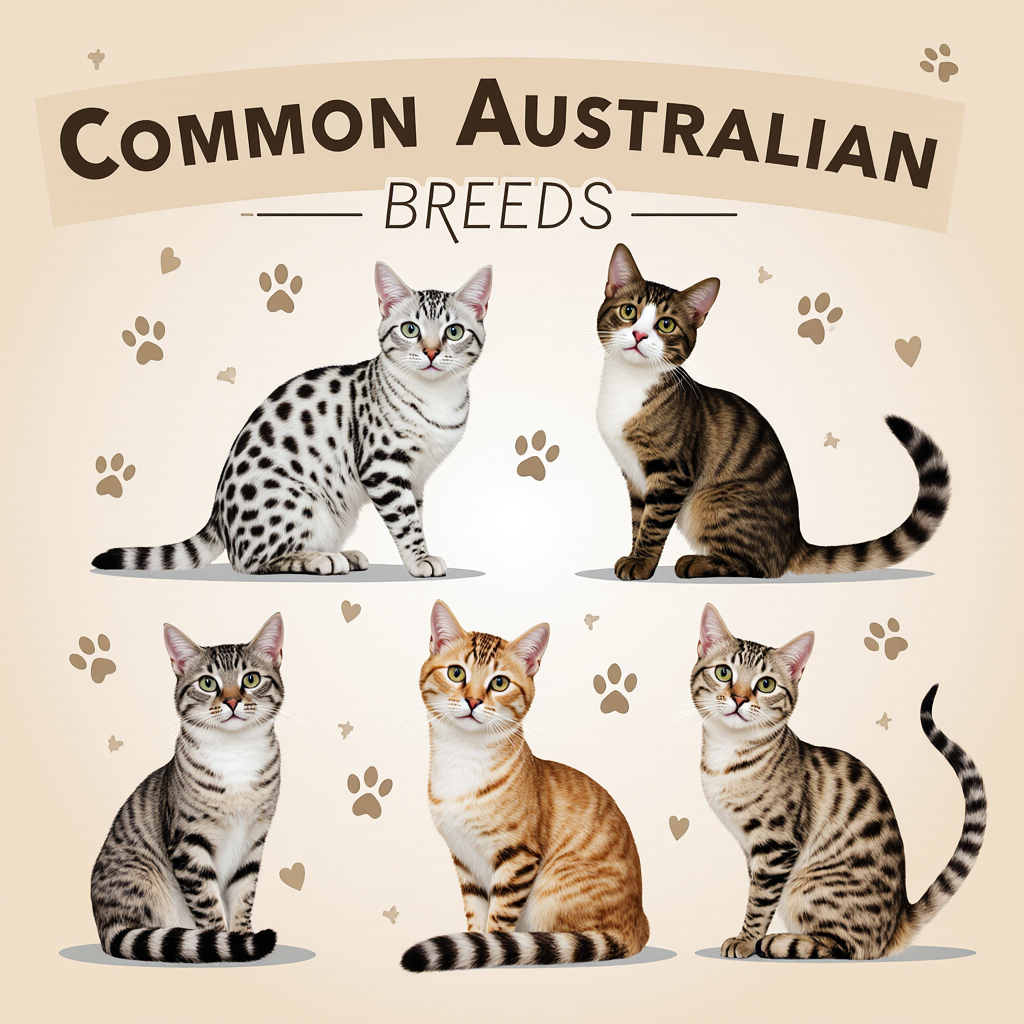
Most Australian cats aren't pedigrees at all. Here's what a domestic shorthair is, which pedigree breeds are most popular here, the one breed developed in Australia, how to work out your cat's ancestry, and how to choose a breed that suits your home.
Australia is a nation of cat lovers. The 2025 Pets in Australia survey by Animal Medicines Australia found that about a third of Australian households have at least one cat. Most of those cats aren't pedigrees, but a handful of pedigree breeds have become very popular here.
Advertisement
This guide covers the most common cats in Australia, the pedigree breeds you're most likely to meet, the one breed developed in Australia, how to work out your cat's background, and how to choose a breed that suits your home.
The most common cat in Australia: the domestic shorthair
The most common cat in Australia isn't a breed at all. It's the domestic shorthair, the everyday cat often called a moggie.
Pet insurance data shows this clearly. Pet Insurance Australia's ranking of the cats it insured in 2019 put the domestic shorthair first and the "domestic house" cat second, with domestic medium hair, domestic longhair, moggie and domestic shorthair cross also in the top eight. Budget Direct's figures for 2023 similarly had the domestic shorthair, domestic medium hair, tabby and domestic longhair among the five most popular cats.
What is a domestic shorthair?
A domestic shorthair is a cat of mixed or unknown ancestry with a short coat. Domestic medium hair and domestic longhair cats are the same thing with longer coats. They aren't a breed with a standard, so they come in every colour, pattern, shape and size.
Some of the names people use for these cats describe a coat pattern, not a breed:
- Tabby is a striped, spotted or swirled pattern, usually with an "M" on the forehead.
- Tortoiseshell (tortie) is a mix of black and orange, or their paler versions. Torties are almost always female.
- Calico is a tortoiseshell pattern with white patches.
- Ginger cats are orange tabbies, and are more often male than female.
- Tuxedo cats are black and white, with a white chest and paws.
Why domestic shorthairs are so popular
- They're easy to find. Shelters and rescue groups have domestic cats of every age, and adoption fees usually include desexing, microchipping and vaccinations.
- Personalities vary. Every domestic cat is an individual, so you can choose an adult cat whose temperament you already know.
- Easy care. A short coat needs little grooming.
- Genetic variety. Crossbred cats have a mix of ancestry. In a large study of cats seen at veterinary practices in England, crossbred cats lived longer on average than purebred cats, with a median of 14.0 years compared with 12.5 years.
If you're thinking about adopting, our guide to kittens for adoption in Melbourne explains how adoption works.
The most popular pedigree breeds in Australia
There are no published national breed registration figures for cats in Australia, so insurance data is the best guide to which pedigree breeds are most common. In both the Pet Insurance Australia and Budget Direct rankings, the Ragdoll was the only pedigree breed in the top group. The Burmese also appeared in the Pet Insurance Australia top eight, and the British Shorthair was that insurer's most insured cat in 2018.
Here are the pedigree breeds you're most likely to meet in Australia.
Ragdoll
Large, calm and affectionate, with a semi-long coat, pointed colouring and blue eyes. Ragdolls are known for being easy to handle and tend to suit families and indoor life. They need weekly grooming, and responsible breeders test for an inherited form of heart disease. See our guide to Ragdoll cats in Australia.
Burmese
A long-time Australian favourite: a compact, muscular cat with a short, glossy coat and golden eyes. Burmese are people-oriented, playful and talkative, and don't like being left alone for long. Australian Burmese have a higher risk of diabetes, so keeping them lean matters. See our guide to Burmese cats in Australia.
British Shorthair
A sturdy, round-faced cat with a dense, plush coat, best known in blue. British Shorthairs are usually calm, independent and undemanding, though many don't love being picked up. Ask breeders about heart and kidney screening.
Maine Coon
One of the largest domestic breeds, with a shaggy coat, tufted ears and a big, bushy tail. Maine Coons are sociable and gentle, and they need regular grooming and plenty of space. See our guides to the Maine Coon and to whether the Maine Coon is the largest cat breed.
Siamese
Slender, pointed and blue-eyed, with a famously loud voice. Siamese are clever, active and very attached to their people, and they need a lot of company and play. See our guide to Siamese cats.
Persian and Exotic Shorthair
The Persian has a long, thick coat and a flat face. The Exotic Shorthair is essentially a short-coated Persian. Both are quiet and gentle. The Persian coat needs daily grooming, and the flat face of both breeds can cause breathing, eye and dental problems, so choose a breeder who breeds for a more moderate face.
Sphynx
A hairless breed with a warm, suede-like skin and a very outgoing personality. Sphynx need regular bathing, protection from sun and cold, and a lot of attention. See our guide to Sphynx cats in Australia.
Scottish Shorthair
The straight-eared relative of the Scottish Fold, with a round face and plush coat. Understand the link to Fold breeding and its health problems before you buy. See our guide to Scottish Shorthair kittens.
Norwegian Forest Cat
A large, longhaired breed from Scandinavia with a thick, water-resistant coat. Friendly and fairly active. See our Norwegian Forest Cat facts.
Birman
A medium-large, semi-longhaired cat with pointed colouring, blue eyes and four white "gloves". Birmans are gentle and sociable, and in a large English study they were among the longest-lived breeds. Their silky coat benefits from a brush once or twice a week.
Other breeds you may see
Australian cat councils also register breeds such as the Abyssinian, Devon Rex, Cornish Rex, Russian Blue, Oriental, Tonkinese and Bengal. Bengals bred in Australia are still available, but since 1 March 2026 Bengal cats can no longer be imported into Australia. See our guide to which cat breeds are allowed in Australia.
The Australian Mist: Australia's own breed
Advertisement
The Australian Mist is the best-known cat breed developed in Australia. It was created by Dr Truda Straede, who began the breeding program in Sydney in the mid-1970s by crossing Burmese, Abyssinian and domestic shorthair cats.
The breed was first recognised in Australia in the 1980s as the Spotted Mist. When cats with a marbled pattern were also accepted, it was renamed the Australian Mist in 1998. It has since been recognised by registries overseas, including The International Cat Association and, in the UK, the Governing Council of the Cat Fancy.
Australian Mists are medium-sized cats with a short coat in spotted or marbled patterns, and colours including brown, blue, chocolate, lilac, gold and peach. They're known for being gentle, people-oriented and happy indoors, which suits Australia's growing number of cat containment rules. See our guide to the Australian Mist.
Are there any native Australian cats?
No. Australia has no native wild species of the cat family. Animals once called "native cats", such as quolls, are carnivorous marsupials. Every cat in Australia, pet or feral, descends from domestic cats brought by Europeans. See our guide to feral cats in Australia.
The most popular cat breeds in the world
Popularity varies between countries and registries, but some breeds are popular almost everywhere. The British Shorthair has long been the UK's most popular pedigree, and the Fédération Internationale Féline ranked it second of 54 breeds in its 2024 registration statistics. The Ragdoll, Maine Coon, Persian, Siamese, Bengal and Sphynx also feature in most international popularity lists.
Popularity doesn't make a breed a good choice for you. Some popular breeds, especially those with flat faces or folded ears, carry serious inherited health problems.
What breed is my cat?
Most cats without papers are domestic shorthairs, medium hairs or longhairs, even if they look like a particular breed. A grey cat with a round face isn't necessarily a British Shorthair, and a pointed cat with blue eyes isn't necessarily a Siamese.
Clues from appearance
You can describe your cat by its coat length, colour, pattern, eye colour and body type. Some features are linked to particular breeds, such as pointed colouring with blue eyes (Siamese, Ragdoll, Birman), very large size with ear tufts (Maine Coon), or a flat face (Persian). But all of these traits also occur in mixed-breed cats.
DNA tests
Cat DNA tests can show whether your cat has ancestry from particular breed groups, and screen for some inherited diseases and coat genes. They're interesting, but most domestic cats descend from random-bred populations rather than pedigree lines, so a result showing some breed ancestry doesn't make a cat a member of that breed.
Pedigree papers
The only way to know for certain that a cat is a particular breed is a pedigree registration with a recognised cat council. A kitten sold as a "Ragdoll" or "British Shorthair" without papers is a domestic cat, whatever it looks like.
Choosing a breed that suits you
Before you choose a breed, think about how you live.
- How much time do you have? Siamese, Burmese and other very social breeds need company and attention every day. A British Shorthair or an adult domestic cat may be happier with more time alone.
- How much grooming can you do? Persians need daily brushing, Ragdolls and Maine Coons need weekly grooming, and most shorthairs need very little. Hairless cats need regular baths.
- Do you want a quiet cat? Siamese and Oriental breeds are vocal. Ragdolls and British Shorthairs are usually quiet.
- Will your cat live indoors? Containment rules are spreading across Australia. Most breeds adapt well to indoor life with enough play, climbing and window time. See our guides to cat laws in Australia and cat enclosures and catios.
- What will it cost? Pedigree kittens from registered breeders cost much more than adoption, and some breeds have higher vet costs. See our guide to the most expensive cat breeds.
- Allergies? No cat breed is hypoallergenic. All cats produce the main cat allergen, though individuals vary. Spend time with the breed before committing.
Buying a pedigree kitten
Buy from a breeder registered with a recognised cat council. Ask about health tests for the breed, meet the mother, see where the kittens are raised, and get a written contract. Registered breeders usually keep kittens until about 12 weeks or older, and most desex pet kittens before they leave.
Adopting
Shelters and rescue groups have cats of every type, including some pedigrees and many pedigree crosses. Adopting an adult cat means you know its personality from the start.
Frequently asked questions
What is the most common cat breed in Australia?
The domestic shorthair, the everyday mixed-breed cat. Among pedigree breeds, insurance data suggests the Ragdoll is the most common.
What cat breeds come from Australia?
The Australian Mist is the best-known breed developed in Australia. It was created in Sydney from Burmese, Abyssinian and domestic shorthair cats.
Is a tabby a breed?
No. Tabby is a coat pattern, with stripes, spots or swirls. Tabbies can be domestic cats or belong to many different breeds.
What is the best cat breed for families?
Calm, tolerant breeds such as the Ragdoll, British Shorthair and Maine Coon are often recommended, but an individual cat's temperament matters more than its breed. An adult shelter cat that's known to be good with children is often a great choice.
What is the best cat breed for an apartment?
Most cats adapt to apartment life if they get enough play, climbing spaces and company. Quieter, less active breeds such as the British Shorthair and Ragdoll often settle easily. Very vocal breeds like the Siamese may not suit close neighbours.
Which cat breeds live the longest?
In a large English study, the Birman, Burmese, Siamese and Persian were among the longest-lived breeds, and crossbred cats lived longer than purebreds on average. Good care matters more than breed.
Can I import any cat breed into Australia?
No. Hybrids between domestic cats and wild cats, such as the Savannah, can't be imported, and Bengals can't be imported since 1 March 2026. See our guide to which cat breeds are allowed in Australia.
Advertisement